Ever Enchanted Duo
If you’ve ever spent twenty minutes scrolling through font marketplaces only to download something that looks stunning in the preview—but falls flat when you actually type “Welcome” or “About Us”—you’re not alone. The Ever Enchanted Duo stands out precisely because it solves that problem: it’s an intentionally balanced pair—no guesswork, no mismatched energy—designed to work together from day one.
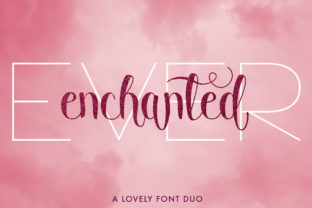
This elegant font duo combines a clean, all-caps sans-serif with a soft, whimsical lowercase script. Neither feels forced or overly ornate; both carry a quiet confidence and a distinctly feminine touch—not in a clichéd way, but through thoughtful proportions, gentle curves, and restrained contrast. It’s the kind of pairing that feels intuitive for wedding stationery, boutique branding, mindful wellness blogs, or even a teacher’s classroom posters—where clarity and charm need to coexist.
Assuming the script works for body text
One of the most common missteps? Using the script face for paragraphs, captions, or navigation labels. The lowercase script in the Ever Enchanted Duo is meant for short, expressive moments—names, quotes, headings, product tags—not long-form reading. Its delicate terminals and variable stroke weight aren’t optimized for screen legibility at small sizes or across devices.
Example: A freelance photographer used the script for her website’s “Services” list—“Portrait Sessions • Family Stories • Milestone Moments”—and saw bounce rates climb by 30% on mobile. Visitors scrolled past without absorbing the offerings. Switching to the sans-serif for list items (keeping the script only for the section header “My Services”) restored readability while preserving personality.
Better approach: Reserve the script for impact—not information. Use the sans-serif for everything functional: menus, buttons, testimonials, pricing tables, and contact details. Let the script breathe where it shines: logos, invitations, chapter titles, or social media quote graphics.
Overlooking spacing and pairing discipline
Because the two fonts share a cohesive aesthetic, it’s tempting to treat them as interchangeable—swapping them mid-sentence or layering them without hierarchy. But elegance comes from restraint. The Ever Enchanted Duo gains its strength from contrast: strong geometry meets lyrical flow. Blur that line, and both lose definition.
For instance, a small business owner added the script inside a sans-serif price tag (“$89 only”), thinking it would add warmth. Instead, it created visual competition—the eye didn’t know where to land, and the price felt less authoritative.
What to check before applying: Ask yourself: Is there clear visual hierarchy? Does one font establish structure (the sans), while the other adds voice (the script)? If both are competing for attention—or if the script appears smaller than intended due to inconsistent x-height or baseline alignment—step back and reset the roles.
Misjudging licensing scope
The Ever Enchanted Duo is typically sold with tiered licenses—personal, commercial, and extended (for templates, SaaS, or resale). Yet many creators assume “commercial use” covers everything, only to realize later their Canva template bundle or Shopify theme requires an extended license. That oversight doesn’t just risk takedowns—it undermines trust with clients who expect professional compliance.
A blogger selling printable planners discovered this after her Etsy shop received a copyright notice. She’d purchased the standard commercial license, but embedding the fonts into downloadable PDFs with editable fields crossed into extended-use territory.
Practical fix: Before downloading or purchasing, read the license summary—not just the headline. Look specifically for terms like “embedding,” “SaaS,” “digital templates,” or “end-user customization.” When in doubt, contact the foundry directly. Most reputable sellers respond within 48 hours—and it’s far quicker than reworking assets post-launch.
Skipping test renders across real contexts
Font previews rarely show how letterforms behave in actual use: subtle kerning gaps in headlines, spacing quirks in all-caps settings, or how the script connects (or doesn’t) between certain letter pairs like “ow” or “th.” Without testing, you might not notice that “Love & Light” looks slightly unbalanced until it’s printed on your client’s invitation suite.
Try this: Type three real-world phrases in both fonts—your business name, a tagline, and a short call-to-action—then view them at actual size on your phone, tablet, and desktop. Print a sample if possible. Pay attention to rhythm, not just appearance. Does the script feel cohesive, or does one letter seem disconnected? Does the sans-serif hold weight at 18px on a retina screen?
Underestimating file management and fallbacks
When using the Ever Enchanted Duo on websites or digital documents, remember: fonts aren’t universally installed. Relying solely on local files without webfont hosting or proper CSS @font-face declarations means your carefully chosen pairing may default to Times New Roman or Helvetica—erasing all intention.
Also worth noting: the duo often ships with OpenType features (like stylistic alternates or ligatures) that won’t activate unless your design tool or platform supports them. In Figma or Adobe apps, those extras are usually accessible via the glyph panel—but in Canva or basic email builders, they’re inactive by default.
Smart habit: Always define a fallback stack. For the sans-serif, try 'Ever Enchanted Sans', 'Helvetica Neue', Arial, sans-serif. For the script, keep it display-only and pair with a safe serif fallback like 'Ever Enchanted Script', Georgia, 'Times New Roman', serif—but only where appropriate. And never assume a browser or app will auto-enable swashes.
Thinking “feminine” means limited application
There’s a quiet misconception that fonts with graceful curves or delicate energy only suit “soft” industries—yoga studios, florists, baby boutiques. But the Ever Enchanted Duo’s strength lies in its quiet authority, not fragility. Used thoughtfully, it brings sophistication to fintech dashboards (via subtle script accents in tooltips), academic newsletters (script pull-quotes beside clean sans-serif body text), or even hardware brand packaging (script logo + bold sans-serif specs).
The key isn’t avoiding contrast—it’s honoring contrast with purpose. A female-led coding bootcamp used the script for their motto (“Build With Belief”) above a stark sans-serif course grid. It signaled values without sacrificing credibility.
So before dismissing the duo as “not for me,” ask: Where could a moment of warmth elevate clarity? Where does your audience need both precision and personality? That’s where the Ever Enchanted Duo earns its place—not as decoration, but as deliberate design language.