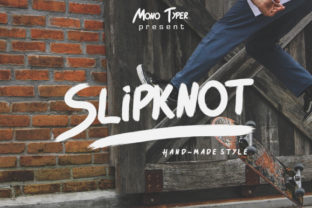
Slipknot: Hand-Made Brush Font with Grit & Personality
Slipknot isn’t polished. It doesn’t try to be. That’s its strength. It’s a rough-around-the-edges, hand-painted brush font—each character drawn with visible pressure, texture, and slight imperfection. There are no vector-perfect curves here, just confident strokes, ink bleed, and intentional asymmetry. If you’ve ever held a stiff-bristled brush loaded with acrylic and dragged it across canvas, you’ll recognize the energy in Slipknot. It’s not decorative filler—it’s a deliberate creative tool for people who value authenticity over automation.
What Makes Slipknot Stand Out (Beyond Looks)
Slipknot works because it balances rawness with usability. Unlike many “grunge” fonts that sacrifice legibility for attitude, Slipknot maintains strong letterforms—even at smaller sizes. Its uppercase-heavy design gives impact without shouting; its irregular baseline and variable stroke weight add rhythm, not confusion. It’s built for real work: posters, packaging, social banners, merch, editorial headlines, and even short UI labels where personality matters more than neutrality.
It’s also highly adaptable. Because it’s rooted in physical media—not algorithmic generation—you can pair it meaningfully with clean sans-serifs (like Inter or Poppins) or textured serifs (like Playfair Display with subtle noise). That contrast creates visual hierarchy *and* narrative: the handmade voice of Slipknot leads, while supporting type keeps things grounded and scannable.
Creative Applications That Actually Work
Slipknot shines where intention meets audience expectation. Here’s how different creators use it—with purpose:
- Small business owners use Slipknot for storefront signage, product labels (especially for artisanal goods like coffee, ceramics, or small-batch soap), and local event posters. A café named “Hearth & Hops” might set its chalkboard menu header in Slipknot—immediately signaling craft, warmth, and human effort.
- Educators and workshop leaders apply it to course titles (“Creative Reboot Lab”), handouts, or slide headers—not for every paragraph, but to anchor key concepts. Students remember the tone because it feels *made*, not templated.
- Bloggers and content creators deploy Slipknot selectively: as a featured quote graphic, a podcast episode title banner, or a newsletter header image. One designer uses it only for her “Unfiltered Friday” series—creating consistency through repetition, not overuse.
- Freelance designers treat it like a signature accent. They’ll set client project names in Slipknot on case study thumbnails, then switch to a neutral body font inside. It adds distinction without compromising professionalism.
How to Use Slipknot Without Losing Clarity
Resist the urge to set entire paragraphs in Slipknot. Its power lies in restraint. Think of it as vocal emphasis—not background music. For best results:
- Use it at larger sizes (36pt+ for print, 48px+ on screen) where texture reads clearly.
- Limit it to one line per layout—a headline, logo lockup, or callout. Never use it for navigation menus or dense captions.
- Test contrast. Pair it with deep charcoal or true black on light cream or off-white paper—or #1a1a1a on #f9f7f3 for web. Avoid pure white backgrounds if printing; they flatten the ink-like depth.
- Check spacing. Kerning isn’t auto-adjusted in all versions, so manually tighten gaps between letters like “AV”, “To”, or “We” if needed—especially in logos.
Variations, Styling, and Smart Tweaks
Slipknot comes in multiple weights (Regular, Bold, sometimes Outline), and some foundries offer alternate characters—swash capitals, flourishes, or shadow variants. Don’t default to the boldest version first. Try Regular for approachability, Bold for urgency, and Outline for layered effects (e.g., fill with a photo or gradient).
You can also reinterpret its spirit digitally: apply subtle grain overlays, add a 1–2px offset shadow for lift, or use clipping masks to reveal Slipknot text over a relevant image (a close-up of paintbrush bristles, raw wood grain, or studio lighting). These aren’t gimmicks—they extend Slipknot’s tactile logic into digital space.
For brand consistency, define clear rules: “Slipknot is used only for primary headlines and logo marks. Never for body copy, pricing, or legal text.” Share those guidelines with collaborators—freelancers, interns, or marketing teams—to preserve intent.
Who Benefits Most—and Why
Slipknot resonates strongest with creators whose work relies on perceived authenticity: makers, independent publishers, indie game studios, community organizers, and educators building trust through transparency. It signals “this was made by someone who cares about the details”—not just the outcome, but the process.
It’s less suited for corporate annual reports, medical device interfaces, or government forms—contexts where neutrality, precision, and universal legibility take priority. That’s not a limitation; it’s clarity of fit. Choosing Slipknot is a decision to foreground humanity in your communication—not hide behind polish.
Getting Started—Practically
If you’re new to Slipknot, start small. Replace one static banner image on your website homepage with a short headline set in Slipknot. Or redesign a single Instagram Story template using it for the main message—then test engagement vs. your usual font. Track whether comments mention “energy,” “vibe,” or “feel” more often.
When licensing, verify file formats (OTF, WOFF2 for web), language support (basic Latin is standard; check for extended diacritics if needed), and commercial use rights—especially if selling templates or merchandise. Some versions include bonus assets: vector brush strokes, texture swatches, or color palettes inspired by dried pigment and studio light.
Most importantly: don’t force it. If Slipknot feels at odds with your current project’s goals—say, launching a fintech dashboard or designing a hospital wayfinding system—set it aside. Its value isn’t universal, but it’s unmistakable where it belongs. That selectivity is what makes it memorable.
Slipknot won’t solve every design problem. But when you need to say something with conviction, warmth, and unmistakable presence—without sounding rehearsed—it’s a tool worth keeping within reach.