Hare Fly: A Handwritten Font That Balances Personality and Practicality
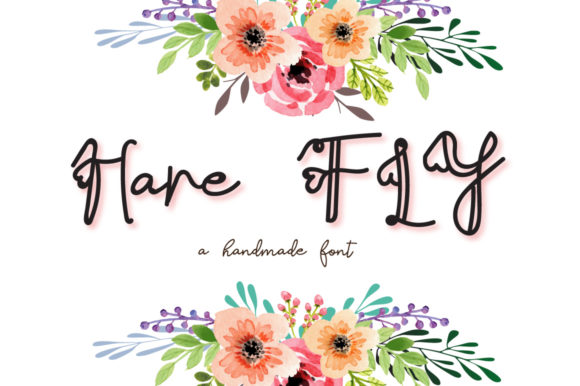
Hare Fly is a handwritten display font that stands out not just for its visual energy but for how thoughtfully it bridges expressiveness with usability. Unlike many script fonts that prioritize flourish over function—or sacrifice legibility for charm—Hare Fly delivers a consistent, confident rhythm while retaining the warmth of human touch. It’s not designed to be invisible background typography; rather, it’s meant to anchor moments where tone, personality, and intention matter: a boutique brand’s launch campaign, an educator’s workshop handout, or a small business’s seasonal social post.
What Makes Hare Fly Distinctive—Beyond First Impressions
At its core, Hare Fly is built on controlled spontaneity. Its letterforms feature subtle variations in stroke weight, gentle tapering, and organic entry/exit strokes—but without excessive swashes or unpredictable ligatures that can hinder readability at smaller sizes or across platforms. The lowercase a, g, and y carry distinctive, friendly shapes that reinforce its character without becoming distracting. Uppercase letters maintain presence without aggression, and spacing has been carefully tuned to avoid crowding in short headlines or tight layouts.
It includes standard Latin characters, numerals, and basic punctuation—no extended language support or stylistic alternates. That’s a limitation for global or multilingual projects, but also a strength for focused use cases: it keeps the file lightweight (under 40 KB as a WOFF2), loads quickly in web environments, and integrates smoothly into design tools like Figma, Adobe Creative Cloud, and Canva without rendering hiccups.
Where Hare Fly Excels—and Where It Doesn’t Try To
Hare Fly performs best when used intentionally—not as body text, not for data-heavy interfaces, and not for long-form editorial content. Its sweet spot is short, high-impact applications: logos, posters, Instagram story headers, product packaging accents, email subject lines, or presentation slide titles. In those contexts, it adds tonal clarity: a handmade ceramics shop gains authenticity with Hare Fly on its “New Glaze Collection” banner; a wellness coach uses it to soften the formality of a “Book Your Session” CTA; a teacher prints classroom reward certificates with just enough whimsy to resonate with students aged 8–12.
It holds up well in print at 24 pt and above, and on screen at 32 px and larger—especially against solid, high-contrast backgrounds. On light gray or textured backgrounds, test contrast carefully: some lighter strokes may fade slightly depending on output resolution or device gamma. For accessibility compliance, always pair it with a clear, highly legible sans-serif (like Inter, Open Sans, or even system fonts) for supporting text and interface labels.
Workflow Integration and Real-World Reliability
As a single-weight, single-style font, Hare Fly doesn’t offer optical sizing or variable axes. That means designers need to make deliberate hierarchy decisions—relying on scale, color, spacing, and companion typefaces rather than built-in weight variation. This isn’t a flaw; it’s a constraint that encourages thoughtful composition. In practice, users report few technical issues: no missing glyphs in common CMS exports, no inconsistent kerning pairs in headline mockups, and stable behavior across browsers (tested in Chrome, Firefox, Safari, and Edge).
Because it lacks italics or bold variants, emphasis must come from context—not formatting. That works well for branding systems where consistency matters more than typographic variety. But it does mean Hare Fly isn’t ideal for publications requiring frequent inline emphasis or nested information layers (e.g., annotated reports or legal disclaimers). Those needs are better served by serif or geometric sans families with full weights and widths.
Audience Fit: Who Benefits Most—and Why
Hare Fly suits professionals who value efficiency *and* emotional resonance. Freelance designers building brand identities for lifestyle brands often choose it for its speed-to-impact ratio: one font file, minimal testing, immediate differentiation from generic sans-serifs. Small business owners without in-house design support appreciate how easily it elevates DIY marketing—adding polish to Canva templates or Mailchimp banners without needing advanced typography knowledge.
Educators find it useful for creating visually inviting learning materials—flashcards, bulletin board headers, or digital worksheets—where approachability supports engagement. Bloggers and content creators use it selectively in featured image text or newsletter banners to signal warmth and individual voice, especially in niches like mindful living, creative entrepreneurship, or family-focused content.
It’s less suited for corporate communications, financial services, or tech documentation—contexts where neutrality, scalability, and strict readability standards take priority. Likewise, teams managing large-scale, multi-language digital products will likely need broader character sets and typographic flexibility than Hare Fly provides.
Practical Recommendations for Getting the Most From Hare Fly
- Pair deliberately: Use it alongside a neutral, highly legible sans-serif (e.g., Inter or Manrope) for body copy, navigation, and captions. Avoid pairing with other decorative or script fonts—it competes rather than complements.
- Respect scale and spacing: At 24–48 px, it reads cleanly. Below 18 px, details blur. Add extra letter-spacing (50–100 units in design tools) for all-caps usage to prevent visual density.
- Test across outputs: Print a sample on your intended paper stock and preview on mobile before finalizing. Some inkjet printers mute fine strokes; OLED screens render them crisply.
- License with intent: Verify usage rights for your project scope—web embedding, desktop use, and commercial redistribution have different requirements. Most reputable foundries provide clear, per-use licensing terms.
Long-Term Value and Design Longevity
Hare Fly avoids trend-driven extremes—no exaggerated bounce, no forced irregularity, no dated embellishments. That gives it staying power beyond seasonal aesthetics. A logo using Hare Fly today won’t feel obviously “2024” in three years. Its balance of friendliness and restraint helps it age gracefully, especially when anchored by strong supporting design choices (color, layout, imagery).
It’s also low-maintenance from a production standpoint: no need to re-export alternate versions for dark mode, no fallback concerns if web loading fails (since it’s rarely used alone), and no version compatibility headaches across software updates. That reliability contributes to real-world efficiency—fewer revisions, fewer client questions about “why does this look different here?”
Ultimately, Hare Fly earns its place not by trying to do everything, but by doing one thing exceptionally well: giving voice to projects that need sincerity, warmth, and quiet confidence—without sacrificing clarity or craft.