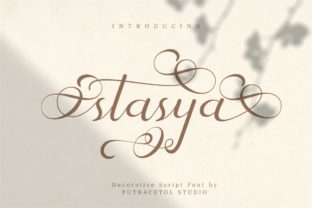
Stasya: Elegant Swirls, Real-World Charm
If you’ve ever paused mid-scroll to admire the delicate curve of a hand-lettered invitation or felt an instant warmth from a boutique’s logo—chances are, you responded to something like Stasya. It’s not just another decorative script font. Stasya is a premium font built for presence: graceful swirls that flow without fuss, generous x-heights that keep charm grounded in clarity, and subtle contrast that whispers elegance instead of shouting it.
Visually, Stasya sits comfortably between classic calligraphy and modern editorial design. Its letterforms feature soft entry and exit strokes, gentle tapering, and rhythmic spacing—never cramped, never sprawling. Unlike many script fonts that sacrifice legibility for flair, Stasya maintains readability at 24pt and above in print, and scales cleanly on retina displays when used thoughtfully. It’s a display font first—but one with enough structural intelligence to earn its place in real projects, not just mood boards.
Where Stasya Earns Its Keep
Stasya shines where personality matters more than neutrality—especially in contexts where your audience expects care, craft, or quiet confidence. Think wedding stationery that feels personal but never cutesy. A small-batch skincare brand whose packaging says “hand-poured” before you even lift the lid. Or a literary magazine’s masthead that invites readers in rather than impressing them with technique.
It works exceptionally well in editorial design: chapter openers, pull quotes, cover titles. In brand identity, it anchors logos for bakeries, florists, indie bookshops, and wellness studios—not as the sole typeface, but as the memorable signature beside a clean sans serif. For social media graphics, Stasya adds warmth to Instagram story headers or Pinterest quote cards without competing with photography. And yes—it holds up in packaging design, especially when printed on textured paper or foil-stamped.
What doesn’t suit Stasya? Dense body copy, technical documentation, legal disclaimers, or any interface demanding rapid scanning. It’s not a workhorse—it’s a highlighter. Use it to signal tone, not transmit data.
How It Shapes Perception—Without Saying a Word
Typefaces don’t communicate in isolation. They reinforce what your brand already says—or quietly undermine it. Stasya leans into sincerity, craftsmanship, and approachable refinement. When paired with a warm neutral palette and thoughtful layout, it tells customers: This was made with attention. You’re worth the extra care.
That impression translates directly to engagement. A boutique’s email subject line set in Stasya stands out in an inbox full of Helvetica. A handmade soap label using Stasya alongside a modest serif (like Merriweather or Lora) feels cohesive—not trendy, not dated, but *considered*. That consistency builds recognition over time. Customers begin to associate those swirls with your voice, your values, your visual rhythm.
Crucially, Stasya avoids looking “generic elegant.” Its slight irregularity—tiny variations in stroke weight, organic baseline movement—keeps it feeling human-made, not algorithmically smoothed. That nuance helps small businesses stand apart from competitors relying on overused script fonts.
Testing, Pairing, and Practical Fit
Before committing, ask two questions: Is this the moment my audience needs warmth—or clarity? and Does Stasya support, rather than distract from, my message? If your goal is conversion-focused landing pages or app navigation, skip it. But if you’re launching a new artisanal tea line or redesigning a poetry chapbook, Stasya deserves serious testing.
Start simple: set your headline in Stasya at 36–48pt, then pair it with a highly legible, low-contrast sans serif (like Inter, Poppins, or Montserrat) for subheads and body text. Avoid overly geometric or rigid companions—the contrast should feel intentional, not jarring. Try setting Stasya in all caps for impact (its uppercase forms are particularly expressive), then drop to sentence case for subtlety.
Check the included styles. Most Stasya licenses include regular and alternate characters—some with extended swashes or discretionary ligatures. These aren’t just flourishes; they’re tools. Use the standard set for clean branding applications. Save the swash variants for hero banners or limited-edition print runs where that extra gesture reinforces exclusivity.
Readability testing matters—even for display fonts. Print a sample at actual size. View it on mobile. Ask someone unfamiliar with your brand: “What’s the first thing you notice?” “What does this feel like?” Their answers reveal more than any spec sheet.
Licensing and Long-Term Use
Stasya is a commercial font, meaning it requires a license for business use—including websites, social assets, product packaging, and client work. Most reputable sellers offer clear, tiered options: desktop-only, webfont, or extended licenses covering apps or ebooks. Always verify usage rights before embedding in a Shopify theme or sending files to a printer.
If you’re a freelancer or agency, confirm whether your license permits use across multiple client projects. Some versions allow unlimited use under a single annual fee—ideal if you regularly design for lifestyle brands or creatives. Others require per-client licensing. Read the fine print, but don’t overcomplicate: reputable foundries make terms transparent, and support is usually responsive.
One final note: Stasya isn’t meant to be everywhere. It’s most powerful when used with restraint—on a business card’s tagline, not the address; in a newsletter’s greeting, not the unsubscribe link. Its strength lies in precision, not volume. That’s what makes it timeless, not trendy.
Whether you’re sketching a logo on paper or building a Shopify store from scratch, Stasya offers something rare in today’s design landscape: unmistakable character, backed by real-world functionality. It doesn’t try to do everything. It does one thing beautifully—and leaves room for everything else to breathe.