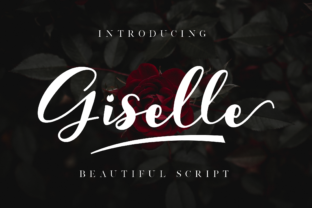
Giselle: A Script Font That Fits Seamlessly Into Real Design Workflows
Giselle is a beautiful script font—elegant, confident, and unmistakably human. It doesn’t shout; it invites. Its graceful letterforms carry the warmth of handwriting without sacrificing clarity or modern proportion. Unlike many script fonts that lean too ornate or too casual, Giselle strikes a balance: refined enough for luxury branding, legible enough for digital interfaces, and expressive enough to convey personality in a single word.
For professionals who manage visual identity across multiple touchpoints—logos, websites, social posts, print collateral, client presentations—Giselle isn’t just another typeface. It’s a consistent voice. It works where tone matters: when you’re introducing a new product line, designing a wedding suite, crafting an Instagram story that reflects your brand’s sincerity, or building stationery that makes every email reply feel intentional.
Where Giselle Fits in Your Creative Process
Most designers don’t choose a font at the end of a project—they anchor their work around one early. Giselle often enters at the definition stage: when you’re clarifying brand voice, sketching mood boards, or aligning with stakeholders on emotional intent. If your goal is “approachable elegance,” “quiet confidence,” or “thoughtful craftsmanship,” Giselle becomes a visual shorthand—not just for aesthetics, but for decision-making criteria.
Before opening design software, many creators use Giselle in low-fidelity mockups: pasting sample headlines into Notion briefs, dropping it into Slack messages to test tone with teammates, or applying it to rough Canva layouts shared with clients. This isn’t about final output—it’s about using Giselle as a filter. Does this headline still feel right in Giselle? Does the tagline lose impact when set in its flowing ‘g’ and tapered ‘t’? These quick checks prevent misalignment later.
Using Giselle Across Platforms and Outputs
Giselle performs consistently across environments—but not identically. Its OpenType features (like contextual alternates and ligatures) shine in design tools like Adobe Illustrator and Figma, where manual kerning and glyph substitution are possible. In those contexts, Giselle supports intentionality: you can fine-tune rhythm between letters for a logo lockup, or adjust spacing for optimal readability in a narrow Instagram bio.
In web environments, Giselle works best as a display font—not body text. Pair it with a clean sans-serif (like Inter, Poppins, or Lato) for hierarchy and contrast. When embedding via @font-face or Google Fonts (if hosted), always include fallbacks and test rendering across Chrome, Safari, and mobile iOS. Giselle’s thin strokes render crisply above 24px on retina displays, but below 18px, legibility drops—so reserve it for headings, quotes, and accent elements, not navigation menus or captions.
For print, Giselle thrives in high-resolution outputs: foil-stamped business cards, letterpress invitations, or embossed packaging. Its subtle variation in stroke weight translates beautifully to physical texture. Just confirm with your printer that the file is exported as vector (not rasterized) and that outlines are converted before final handoff—this preserves the integrity of curves and terminals.
Workflow Integration: Before, During, and After Design
Before: Giselle helps shape expectations. When briefing a freelance designer or presenting to internal marketing teams, including Giselle in your brand guidelines—even as a “recommended display font”—signals aesthetic boundaries. It reduces back-and-forth on “too formal” or “too playful.” It also informs asset planning: if Giselle will appear on merchandise, ensure your embroidery digitizer or vinyl cutter supports its fine details.
During: In collaborative tools like Figma, naming layers clearly (“Giselle – H1 Primary,” “Giselle – CTA Button”) keeps variants organized. Use component libraries to store common Giselle-based elements: a testimonial badge, a newsletter sign-up header, or a product feature label. This builds consistency without manual reapplication—and makes updates scalable. If your team uses design tokens, map Giselle to a typography scale tier (e.g., “display-1”) rather than hardcoding sizes.
After: Giselle supports long-term brand health. When auditing assets quarterly—checking for outdated fonts, inconsistent weights, or broken web embeds—Giselle serves as a checkpoint. Is it still being used where it adds value? Has overuse diluted its impact (e.g., slapped onto every banner without hierarchy)? Revisiting usage patterns helps maintain its perceived quality and prevents visual fatigue.
Compatibility and Practical Constraints
Giselle is a single-weight, script-only family—no bold, italic, or condensed variants. That’s a constraint, yes—but also a strength. It forces focus: if you need emphasis, you change size, color, or spacing—not weight. This simplifies typographic systems and reduces cognitive load for both designers and viewers.
It does not include extended Latin characters (e.g., ř, ł, ñ with diacritics beyond basic accented vowels), so international projects require evaluation. If your audience includes Spanish, Czech, or Vietnamese speakers, test key phrases early—or pair Giselle with a robust supporting font for body copy where multilingual support is essential.
Also consider licensing. Giselle is typically offered under desktop + web licenses. If you’re building a SaaS dashboard where users generate branded PDFs using Giselle, verify whether your license covers dynamic embedding. Some foundries require extended licensing for server-side rendering—don’t assume standard terms apply.
Practical Tips for Sustainable Use
- Limit usage to three primary roles: e.g., logo wordmark, section headers, and callout quotes. Avoid using it for lists, captions, or data labels—clarity suffers.
- Test contrast rigorously: Giselle’s thin strokes demand sufficient background contrast. At 4.5:1 minimum (WCAG AA), it remains readable. On light gray or pastel backgrounds, increase font size or add subtle drop shadows—not as decoration, but as functional enhancement.
- Pair with intention: Its elegance pairs best with neutral, structured companions—not other scripts or overly decorative fonts. Think: Giselle for “Our Story,” Inter for “Founded in 2018 • 37 Clients Served.”
- Store usage rules in documentation: Note which glyphs to avoid (e.g., the discretionary ‘&’ or swash capitals) in certain contexts, and when to substitute standard forms for accessibility (e.g., in alt text descriptions or screen reader–friendly PDFs).
Why Consistency With Giselle Pays Off Long-Term
Brands that use Giselle thoughtfully—only where its qualities directly serve communication goals—build recognition faster. A boutique bakery doesn’t need Giselle on ingredient labels; they do need it on the chalkboard-style menu board and thank-you cards. That selectivity trains audiences: when they see Giselle, they know it signals care, craft, and intention.
For educators designing course materials, Giselle works well in slide headers or certificate templates—adding warmth without undermining authority. For freelancers building personal brands, it elevates proposal headers and portfolio project titles, reinforcing professionalism through detail. For small business owners updating social bios seasonally, swapping only the color or background behind Giselle text creates freshness without redesigning everything.
Giselle doesn’t replace strategy—it clarifies it. When your process includes deliberate font selection, testing in context, documenting usage, and auditing over time, Giselle becomes more than a stylistic choice. It becomes part of how you deliver quality, maintain coherence, and communicate what matters—without saying a word.