Ganesha: A Luxurious Script Font That Elevates Real-World Design
If you’ve ever spent 20 minutes scrolling through font libraries trying to find something that feels both elegant and grounded—something that doesn’t look like it belongs on a wedding invitation *or* a yoga retreat flyer alone—you’ve probably paused on Ganesha. It’s not just another script font. It’s a carefully crafted balance of bold presence and delicate movement, with curves that flow like ink pulled by hand—not generated, not smoothed into sterility, but shaped with intention.
What Ganesha Actually Is (and What It Isn’t)
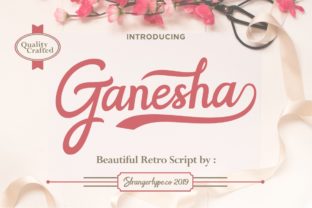
Ganesha is a beautiful script font designed for impact without sacrificing warmth. Its letters have generous spacing, confident weight shifts, and subtle tapering that gives each character breathing room—even at small sizes. Unlike many decorative scripts that vanish into illegibility below 24pt, Ganesha holds up well in headlines, short quotes, and even medium-length pull quotes in editorial layouts. And those decorative flower frames? They’re not afterthoughts. They’re purpose-built companions—ornamental but never overwhelming—that echo the font’s rhythm and reinforce its luxurious tone.
It’s not a workhorse body text font. You won’t use Ganesha for blog paragraphs or product descriptions. And it’s not meant for logos that need extreme scalability across tiny app icons and billboard banners. But where it shines—consistently, reliably—is anywhere you need to signal care, craftsmanship, or quiet confidence.
When and Where Ganesha Fits Into Real Creative Work
Think about the last time you designed something that needed to feel intentional—not trendy, not minimal, but *considered*. Maybe it was a small-batch candle label, a workshop flyer for mindful leadership, or the cover of an independent poetry chapbook. Those are the moments Ganesha earns its place.
For Creators & Freelancers Building Their Visual Identity
A ceramicist launching her first online shop might use Ganesha for her logo lockup alongside a clean sans-serif for supporting text. The contrast says: “I’m rooted in tradition, but I speak clearly today.” Similarly, a freelance copywriter crafting a signature email header or proposal cover page can use Ganesha for their name—adding visual distinction before the reader even scrolls to the first line of copy. It’s not about shouting; it’s about being remembered for how something *feels*.
For Educators & Coaches Creating Thoughtful Materials
An educator designing a reflection worksheet for students might set the title in Ganesha—paired with soft floral framing—to gently elevate the tone of the activity. It signals respect for the process, not just the outcome. A life coach offering guided journaling prompts could use Ganesha for section headers (“Pause Here,” “What Wants Attention?”) to create rhythmic, almost ceremonial breaks in the layout—inviting slower engagement, not faster skimming.
For Small Business Owners With Physical Touchpoints
That local apothecary adding custom-printed thank-you cards to every order? Ganesha works beautifully on textured paper, especially when printed with slight ink bleed or letterpress impression. The curves soften the formality; the boldness ensures legibility even with tactile finishes. Likewise, a boutique bakery printing seasonal menu boards—think lavender honey scones or spiced pear tarts—can use Ganesha for dish names, letting the font carry warmth and seasonality without needing extra illustration.
How to Use Ganesha Without Overdoing It
The biggest mistake people make with fonts like Ganesha isn’t using them too little—it’s using them too much. Because it’s expressive, it’s tempting to apply it everywhere: headings, subheads, buttons, captions. Resist that. Ganesha gains power from restraint.
- Use it for one clear focal point per layout—a headline, a name, a single evocative phrase.
- Pair it thoughtfully: try a neutral, open sans-serif (like Inter, Poppins, or Lato) for supporting text. Avoid other decorative fonts—they’ll compete, not complement.
- Test readability early: paste your actual text—not lorem ipsum—into a mockup. Does “Limited Edition Launch” read instantly, or does the eye hesitate on the ‘g’ or ‘s’? Trust that hesitation.
- Consider context before committing: If your audience primarily engages on mobile, avoid Ganesha in long navigation labels or CTA buttons. Save it for hero sections or email subject lines where users pause and absorb.
What to Know Before Downloading or Licensing Ganesha
Ganesha is typically offered as a desktop license—meaning it’s installed on your machine for design apps like Adobe Illustrator, Affinity Designer, or Figma (via plugins). It’s not usually web-font ready out of the box, so if you want to use it live on your website, check whether the foundry offers a web version—and what the hosting or bandwidth terms are. Some versions include OpenType features like alternate characters or ligatures; explore those in your design software to add subtle variation (e.g., swapping the default ‘&’ for a more ornate version in a logo).
Also, consider your distribution needs. If you’re creating templates for clients (Canva, PowerPoint, Google Slides), know that Ganesha won’t render unless the end user has it installed—so you’ll need fallback options or embedded PDF exports for consistency.
Why Ganesha Stands Out in a Crowded Font Landscape
There’s no shortage of script fonts promising elegance or uniqueness. What sets Ganesha apart is how its beauty serves function—not just aesthetics. The curves aren’t arbitrary; they guide the eye smoothly across words. The boldness isn’t aggressive; it’s anchoring. And the floral frames don’t distract—they deepen the mood, like choosing the right frame for a watercolor painting.
You’ll notice this most when you step back from the screen. A business card with Ganesha used sparingly doesn’t just look polished—it feels *held*. A digital course landing page with Ganesha in the headline doesn’t just stand out in a feed—it invites pause. That’s not magic. It’s thoughtful design architecture, built into the letterforms themselves.
So if you’re selecting fonts not just to fill space, but to shape how people experience your work—whether it’s a handmade greeting card, a client presentation, or the opening line of your next newsletter—Ganesha isn’t just an option. It’s a quiet, confident choice for people who believe clarity and beauty don’t have to compete.