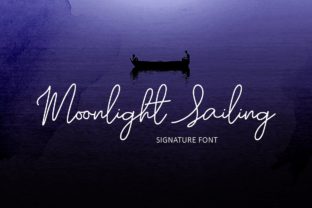
Moonlight Sailing Script
Moonlight Sailing Script is a gorgeously crafted handwritten font designed to evoke authenticity, warmth, and intention. Unlike rigid display fonts or over-processed script variants, it features natural stroke variation, subtle ink texture, and double ligatures that mimic the organic flow of pen-on-paper writing. It’s not just decorative—it’s functional typography built for clarity and character in real-world use.
Where Moonlight Sailing Script Fits in Your Creative Workflow
Fonts are rarely chosen in isolation—they’re selected as part of a larger process: defining tone, reinforcing brand voice, guiding attention, or humanizing digital interfaces. Moonlight Sailing Script enters that process at the intersection of personality and precision. It’s especially effective when you need to signal approachability without sacrificing professionalism—think hand-signed invitations, boutique packaging labels, educator newsletters, or small business social media graphics.
Its double ligatures—where certain letter pairs (like “fi”, “fl”, “th”, or “st”) connect with graceful, intentional strokes—aren’t just aesthetic flourishes. They reduce visual clutter and improve reading rhythm at medium sizes, making the font more legible than many script alternatives in short-form contexts like Instagram captions or email subject lines.
Using It Before a Project: Setting Intention and Tone
Before launching a new campaign, rebranding effort, or content series, designers and marketers often build mood boards, define audience personas, and establish visual guidelines. That’s the ideal moment to test Moonlight Sailing Script—not just as a typeface, but as a tonal anchor. Try pairing it with neutral sans-serifs (e.g., Inter or Lato) for body text. This contrast creates hierarchy while preserving warmth: Moonlight Sailing Script handles headlines, quotes, and callouts; supporting fonts handle detail and structure.
For educators preparing course materials or freelancers drafting client proposals, using Moonlight Sailing Script early in mockups helps clarify whether the project’s emotional resonance aligns with its goals. If your goal is to feel personal and grounded—not flashy or corporate—this font will reinforce that direction from day one.
During Execution: Practical Integration Across Platforms
Compatibility matters. Moonlight Sailing Script is available in OTF and TTF formats, making it usable in Adobe Creative Cloud apps (Photoshop, Illustrator, InDesign), Figma (via desktop plugin or variable font setup), Canva (uploaded as custom font), and even modern web projects via @font-face embedding. It does not require special licensing for commercial use—important for small business owners managing their own branding assets.
In practice, avoid using it for long paragraphs or data-heavy tables. Its strength lies in controlled, high-impact applications: a signature line beneath a blog post, a handwritten-style tagline on a product label, or animated text overlays in short-form video. When used in motion graphics, its natural stroke flow translates well to path-based animation—especially when paired with easing that mimics hand-drawn motion.
One practical tip: always test readability at actual usage size. At 14px on screen or 8pt in print, some ligatures may tighten or obscure adjacent letters. Use the font’s stylistic alternates (if available in your version) to swap in cleaner variants where needed—many professional releases include optional single-story “a” and “g”, or simplified “t” forms for improved legibility.
After Launch: Consistency, Refinement, and Long-Term Use
Once deployed, Moonlight Sailing Script becomes part of your asset library—and consistency follows. Keep a simple style guide snippet: specify primary use cases (e.g., “Headlines only, max 3 lines”), color contrast minimums (4.5:1 against background), and spacing rules (e.g., “120% line-height minimum for digital use”). This prevents drift across team members or tools, especially when non-designers contribute to marketing assets.
Over time, observe how audiences respond. Does engagement increase on posts featuring Moonlight Sailing Script headlines? Do customers mention the “handwritten feel” of your packaging? These qualitative signals help validate whether the font supports—not distracts from—your core message. If usage feels forced or inconsistent, revisit the original intent: was it meant to soften a technical offering? Add intimacy to a wellness brand? Clarify authorship in educational content? Let those goals guide refinement—not trends.
How It Works With Other Tools and Methods
Moonlight Sailing Script doesn’t replace systems—it complements them. Pair it with structured frameworks like the Brand Voice Chart (to define when and why you’d choose warmth over authority) or the Content Hierarchy Canvas (to map where handwritten emphasis adds value). In Notion or Airtable, use it in branded templates—not for database fields, but for section headers or welcome messages that set tone before users dive into functionality.
For bloggers and newsletter writers, integrate it into email design by exporting stylized headers as SVGs (for crisp scaling) rather than embedding the font directly—ensuring consistent rendering across clients like Gmail or Outlook. For print designers, embed the font fully in PDF exports and confirm ligature behavior remains intact during preflight checks.
It also pairs thoughtfully with tactile workflows. If you sketch concepts by hand before digitizing, Moonlight Sailing Script’s natural rhythm mirrors that physical process—making transitions from analog to digital feel less jarring. Similarly, if you use handwriting for note-taking or planning, this font can extend that same cognitive continuity into final deliverables.
What to Consider Before Adopting It
Not every project needs a handwritten font—and Moonlight Sailing Script works best when its qualities serve a clear purpose. Ask yourself:
- Is legibility at scale a priority? If your main touchpoints are billboards or mobile app buttons, consider a more robust script—or reserve Moonlight Sailing Script for secondary elements only.
- Do you have control over font loading? On websites, self-hosting ensures reliability. Relying on third-party CDNs may introduce delays or fallback issues.
- Is your team comfortable adjusting tracking and kerning? Handwritten fonts often benefit from manual spacing tweaks—especially in all-caps or tight headline settings.
- Does it reflect your audience’s expectations? A fintech startup targeting institutional investors may find it too informal; a ceramicist launching an online shop will likely find it resonant.
Real-World Implementation Examples
A freelance illustrator uses Moonlight Sailing Script for client-facing invoices—not for line items, but for the “Thank you” header and her handwritten-style signature block. It reinforces her personal brand without compromising professionalism.
An online yoga instructor applies it to workshop titles and quote graphics shared across Instagram Stories. She pairs it with a clean, low-contrast sans-serif for dates and logistics—keeping information scannable while preserving emotional tone.
A small publisher uses it exclusively for author bios in their quarterly literary journal—never for article titles or body text. Readers begin associating the font with voice, craft, and individuality, strengthening the journal’s identity over time.
None of these uses rely on novelty. Each is rooted in workflow logic: where emphasis is needed, where personality adds value, and where consistency builds recognition.
Final Thought: Typography as Quiet Strategy
Moonlight Sailing Script isn’t about standing out for the sake of visibility. It’s about aligning form with function—using a tool whose naturalness supports clarity, whose ligatures aid flow, and whose warmth invites attention without demanding it. When integrated with intention—not just aesthetics—it becomes part of how people experience your work, remember your message, and trust your voice. That kind of integration doesn’t happen by default. It happens through deliberate placement, thoughtful testing, and ongoing alignment with what matters most in your process.