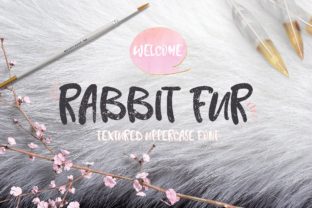
Rabbit Fur: A Textured Uppercase Font
Rabbit Fur isn’t just another display font—it’s a tactile, expressive typeface built for impact. Every letter is hand-crafted with soft curves, subtle irregularities, and generous rounded forms that mimic the plush density of its namesake. Unlike sterile geometric caps or rigid monoline fonts, Rabbit Fur carries warmth and personality without sacrificing clarity. It’s designed exclusively in uppercase, making it ideal for short, high-visibility applications: logos, posters, social banners, packaging accents, and editorial headlines.
Why This Font Resonates—Across Different Goals
What makes Rabbit Fur meaningful depends entirely on what you’re trying to do—and who you are while doing it. A freelance illustrator might reach for it to add playful contrast to a children’s book cover. A small-batch candle maker could use it to label jars with quiet confidence. A university lecturer might drop it into a slide title to hold attention without overwhelming content. The same font serves different purposes because typography isn’t neutral—it’s functional, emotional, and contextual.
For Designers & Creatives
If you work with visual storytelling—whether branding, UI mockups, or print layouts—Rabbit Fur offers immediate texture and tonal distinction. Its irregular stroke weight and organic terminals avoid digital sterility, helping your work feel human-made, not algorithm-generated. You’ll likely test it alongside sans-serifs like Inter or Manrope for contrast, using Rabbit Fur only where emphasis matters most: a tagline, a chapter opener, or a product name. Because it’s uppercase-only, it won’t replace body text—but it excels at anchoring hierarchy. Try pairing it with a clean, low-contrast sans-serif for balance. No need to overthink alignment: its generous x-height and open counters make it legible even at medium sizes on screen.
For Small Business Owners & Marketers
You’re not choosing a font to win a design award—you’re choosing one that communicates trust, approachability, or craft in under two seconds. Rabbit Fur signals care and intentionality. That’s valuable if your brand leans into handmade goods, wellness, boutique services, or lifestyle content. Imagine it on a reusable tote bag, an Instagram Story highlight, or a café chalkboard menu. It doesn’t scream “discount” or “urgent”—it whispers “thoughtful.” If your audience skews 30–50 and values authenticity over flash, Rabbit Fur fits naturally. Just avoid stretching it across long paragraphs or dense web navigation; its strength is brevity and presence, not endurance.
For Educators & Content Creators
When you design learning materials—slide decks, workshop handouts, or digital course thumbnails—legibility and tone both matter. Rabbit Fur stands out without triggering visual fatigue. Its rounded shapes soften formality, which helps lower perceived barriers for learners who associate sharp, angular fonts with authority or rigidity. One educator used it for weekly “Key Idea” headers in her science newsletter, reporting higher open rates and fewer comments about “feeling overwhelmed.” Another embedded it in Canva templates for student project titles—finding it boosted engagement more than standard Google Fonts. It works best when paired with highly readable body fonts (like Open Sans or Lato) and ample white space.
For Hobbyists & DIY Enthusiasts
You don’t need design training to appreciate how Rabbit Fur changes the mood of a project. Printing custom greeting cards? Its soft edges lend charm without looking childish. Designing a wedding invitation suite? It adds warmth next to delicate script fonts. Even cutting vinyl decals for a home office sign feels more intentional with Rabbit Fur guiding the eye. Because it’s straightforward to install and use in tools like Cricut Design Space, Adobe Express, or Canva, there’s no steep learning curve—just drag, type, and adjust tracking. Beginners often start by replacing default bold caps in existing templates, then gradually experiment with size, color, and spacing as confidence grows.
What to Consider Before You Use It
Rabbit Fur isn’t universal—and that’s part of its value. Here’s how to know if it aligns with your needs:
- Ease of use: Installs like any desktop font (OTF/TTF). Works natively in Figma, Illustrator, Photoshop, and most modern web builders. No coding required for basic use.
- Flexibility: Limited to uppercase letters, numbers, and basic punctuation. No lowercase, no italics, no stylistic alternates. That’s intentional—not a gap to fill.
- Commercial use: Check the license before deploying in client work or products for sale. Most versions permit commercial use, but some require attribution or a paid upgrade for extended rights.
- Web performance: As a display font, it’s best loaded selectively—not as a site-wide heading font. Use
@font-facewithfont-display: swapto avoid invisible text delays. - Accessibility: Its rounded, high-contrast forms support readability at larger sizes, but avoid using it for UI labels, form fields, or small body copy where clarity trumps character.
A Real-World Example Across Roles
A local pottery studio owner named Maya uses Rabbit Fur in three distinct ways:
- On her website banner (“Hand-Built Ceramics Since 2018”)—paired with Montserrat for subheadings—to convey craftsmanship and calm.
- In her Etsy shop banner image—set at 72pt with tight letter-spacing—to reinforce brand recognition across devices.
- As a watermark on Instagram Reels showing new glaze tests—subtle enough not to distract, strong enough to be seen.
Does Rabbit Fur Fit Your Next Project?
Ask yourself:
- Is this for a short, focused message—not a paragraph or interface?
- Do I want warmth, tactility, or gentle authority—not neutrality or urgency?
- Am I okay limiting it to headings, logos, signs, or decorative elements?
- Does my audience respond well to approachable, human-scaled design?
At its core, Rabbit Fur reminds us that type isn’t just about transmitting words—it’s about shaping how those words land. Whether you’re launching a product, teaching a concept, or making something just for joy, the right font can help your intent arrive exactly as intended: clear, kind, and unmistakably yours.