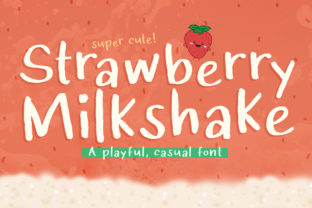
Strawberry Milkshake Font
Strawberry Milkshake is a display typeface designed for impact—not utility. It’s not meant for body text, data tables, or interface labels. Instead, it thrives where personality matters most: logos, social media graphics, packaging accents, greeting cards, and short-form promotional visuals. Its charm lies in its deliberate imperfection: uneven stroke weights, slightly wobbly baselines, and rounded, marker-like terminals that evoke hand-drawn spontaneity. Unlike many “playful” fonts that rely on excessive bounce or cartoonish exaggeration, Strawberry Milkshake balances sweetness with restraint—making it usable without feeling cloying.
What Makes Strawberry Milkshake Distinctive
At first glance, Strawberry Milkshake reads as cheerful—but closer inspection reveals thoughtful construction. Each character maintains consistent x-height and spacing, avoiding the inconsistent kerning or erratic sizing that plagues lower-quality script or novelty fonts. The lowercase a, g, and y feature open, friendly counters; capitals have gentle curves rather than sharp angles. There’s no shadow, outline, or built-in texture—just clean vector outlines optimized for scaling. That means it holds up well at 24px on a mobile banner or 200pt on a café chalkboard poster.
The font includes standard Latin characters (A–Z, a–z), numerals, basic punctuation, and common diacritics—enough for English-language branding and short multilingual phrases (e.g., “Taste the Joy 🍓”, “¡Delicioso!”). It does not support extended Cyrillic, Arabic, or CJK scripts, nor does it offer stylistic alternates, ligatures, or optical sizes. This isn’t a limitation—it’s a design decision aligned with its purpose: focused, expressive, and fast to deploy.
Where Strawberry Milkshake Delivers Real Value
For small business owners launching a new product line—say, an organic snack brand targeting parents and young professionals—Strawberry Milkshake works effectively in specific, high-visibility contexts. Used sparingly on a product label’s flavor name (“Strawberry Bliss”), it signals approachability and freshness without sacrificing legibility. Similarly, educators designing classroom posters for early literacy units find it resonates with K–2 students: its soft shapes reduce visual stress while supporting letter recognition.
Freelance designers report reliable performance in Adobe Creative Cloud apps and Figma. It imports cleanly, renders consistently across macOS and Windows, and exports crisply to PDF and PNG. No glyph substitution issues, no missing characters in standard workflows. One designer noted using it for a local bakery’s Instagram carousel—paired with a neutral sans-serif (like Inter or Open Sans) for captions—and saw a measurable increase in engagement on posts featuring Strawberry Milkshake headlines versus previous serif-based layouts.
Practical Use Cases and Pairing Strategies
Strawberry Milkshake performs best when contrasted—not crowded. It gains clarity and authority next to a highly legible, low-contrast sans-serif. Avoid pairing it with other decorative fonts, condensed typefaces, or overly geometric options like Futura or Montserrat Bold, which create visual tension rather than harmony. A balanced combination might be:
- Headline: Strawberry Milkshake (regular weight)
- Subhead/Body: Inter Light or Lato Regular (size-adjusted for hierarchy)
- Accent: Minimal iconography—simple line art, not detailed illustrations
It also functions well in motion graphics when animated subtly—slight bounce on entry, gentle scale-up—because its forms are simple enough to avoid rendering artifacts. However, avoid rapid rotation or distortion effects: the font wasn’t engineered for kinetic manipulation, and overuse dilutes its impact.
Limitations Worth Acknowledging
Strawberry Milkshake is intentionally narrow in scope. It doesn’t solve typographic problems requiring versatility—such as long-form reading, accessibility compliance (its contrast ratio falls below WCAG AA at small sizes), or multilingual publishing. It lacks bold or italic variants, so emphasis must come from size, color, or layout—not weight shifts. And while its playfulness reads well for youth-oriented or lifestyle brands, it may feel incongruous in contexts demanding authority or gravitas—think legal disclaimers, financial reports, or healthcare communications.
Another practical note: licensing. Strawberry Milkshake is available through reputable foundries and marketplaces (e.g., Creative Market, MyFonts) under standard desktop + web licenses. Always verify usage rights before embedding in SaaS platforms or white-labeled tools—some extended licenses require additional fees for app or digital product integration.
Audience Fit: Who Benefits Most—and When
Entrepreneurs building DTC brands in food, beauty, wellness, or children’s products often cite Strawberry Milkshake as a go-to for initial mood boards and customer-facing assets. Its tone aligns with audiences who respond to warmth over polish—think Etsy sellers, indie publishers, or boutique studio owners crafting limited-edition prints.
Bloggers and content creators focusing on lifestyle, parenting, or education use it selectively in featured image titles or newsletter headers—not as a site-wide font, but as a recurring visual signature. One educator shared using it only for weekly “Fun Fact Friday” banners, creating predictable delight without overwhelming students’ visual field.
Marketing teams evaluating fonts for seasonal campaigns (e.g., summer promotions, holiday collections) appreciate its speed-to-implementation. With no learning curve and minimal testing required, it reduces time spent iterating on tone. But it’s rarely chosen for core brand identity systems unless playfulness is central to the mission—like a toy company or a creative workshop space.
Long-Term Considerations and Alternatives
Typography choices accumulate meaning over time. Strawberry Milkshake carries strong associative cues: sweetness, nostalgia, informality. That makes it memorable—but also potentially limiting if brand evolution calls for greater sophistication or broader demographic reach. Teams planning multi-year roadmaps should consider whether its voice remains flexible enough to grow alongside messaging strategy.
If Strawberry Milkshake feels *almost* right but needs more versatility, alternatives worth testing include:
- Cherry Swash — offers swash variants and a slightly more refined baseline, better suited for editorial use
- Qwigley — similar energy but with tighter spacing and improved numeral clarity
- Bad Script — more calligraphic, less “marker,” useful when elegance is needed alongside whimsy
None replicate Strawberry Milkshake’s exact balance of simplicity and charm—but each addresses adjacent needs with comparable quality and licensing transparency.
In practice, Strawberry Milkshake earns its place not as a default, but as a deliberate choice—a tool pulled out when authenticity, warmth, and instant readability matter more than neutrality or scalability. It works because it doesn’t try to do everything. Used with intention, it adds character without confusion, joy without clutter, and distinction without distraction.