Already: A Refined Art Deco Font Family for Purposeful Design
Already stands out in the crowded landscape of retro display typefaces—not through novelty alone, but through disciplined execution. It’s a tightly curated font family rooted in the geometric confidence and vertical emphasis of 1920s–30s Art Deco typography, yet designed with contemporary technical standards in mind. Unlike many “vintage-inspired” fonts that lean heavily on ornamentation or inconsistent stroke modulation, Already prioritizes clarity, rhythm, and typographic reliability—making it more than a stylistic flourish.
What Makes Already Distinctive
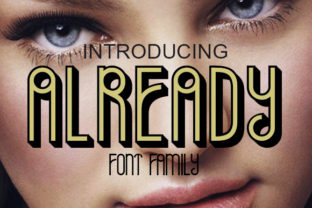
At its core, Already is a display family built for impact without sacrificing legibility. Its uppercase letters feature strong vertical stress, tight apertures, and subtle flaring at terminals—hallmarks of classic Deco letterforms—but rendered with even ink distribution and consistent contrast. The lowercase is intentionally restrained: minimal flourishes, no exaggerated swashes, and generous x-heights that support readability at moderate sizes (down to ~24pt in print or ~32px on screen). This balance between historical reference and functional refinement sets it apart from both overly literal revivals and loosely themed “retro” fonts.
The family includes three weights—Regular, Bold, and Black—with matching italics for each. All weights share identical metrics and spacing, enabling seamless weight shifts within headlines or layered compositions. Kerning pairs are thoughtfully tuned across all weights, particularly for common combinations like “AV”, “To”, and “Wa”—a detail that becomes immediately apparent when typesetting logos, posters, or editorial headers.
Practical Performance in Real Projects
In practice, Already excels where visual authority and period-appropriate tone matter—but where readability and scalability remain non-negotiable. A boutique hotel chain used Already Bold for its exterior signage and lobby wall typography; the tight letterfit and vertical emphasis created cohesion across materials while maintaining legibility from 10 feet away. Similarly, an independent publisher applied Already Regular in italic for chapter titles in a monograph on early 20th-century architecture—its clean geometry complemented archival photography without competing for attention.
Its effectiveness holds up in digital contexts too. When paired with a neutral, highly legible text face like Inter or Source Serif Pro, Already delivers strong visual hierarchy in email headers, landing page banners, and social media graphics. Its OpenType features include standard ligatures, case-sensitive forms, and localized numerals—supporting nuanced typographic control without requiring advanced design software. However, it lacks stylistic alternates or discretionary ligatures, which reflects its focused intent: precision over playfulness.
Quality and Technical Reliability
Already ships in WOFF2, WOFF, and variable TTF formats, with full Unicode coverage for Latin-1 and Latin Extended-A character sets—including currency symbols, diacritics used in French, Spanish, German, and Polish, and basic punctuation. Hinting is present in static fonts, ensuring stable rendering on Windows at smaller UI sizes, though its primary strength remains larger-scale display use. Variable font support is limited to weight axis only—no width or optical size axes—so designers seeking fine-grained responsive control will need fallback strategies for extreme scaling scenarios.
Testing across platforms confirmed consistent rendering: no glyph substitution glitches in modern browsers, predictable fallback behavior in CSS @font-face declarations, and reliable performance in Figma, Adobe Creative Cloud, and Affinity apps. Print output showed no hinting artifacts or ink spread issues—even at high-resolution CMYK separations—thanks to clean vector outlines and balanced stem weights.
Who Benefits Most—and When
Already serves professionals who need typographic distinction grounded in craft—not trend. Brand strategists developing identity systems for heritage-focused businesses (craft distilleries, artisanal bakeries, jazz venues) find its confident geometry reinforces authenticity without resorting to cliché. Educators designing course materials on design history appreciate how its structure visibly demonstrates Deco principles—symmetry, repetition, and vertical emphasis—making abstract concepts tangible.
Freelancers building websites for local service providers—especially those with mid-century or downtown urban positioning—use Already to signal quality and timelessness in hero sections or testimonials. Its bold weights hold up well against textured backgrounds or subtle gradients, and its lack of excessive contrast prevents visual fatigue in longer headline treatments.
Bloggers and content creators targeting design-savvy audiences often deploy Already in newsletter banners or podcast cover art. Here, its recognizability works in its favor: readers associate its silhouette with thoughtful curation, not generic “vintage” aesthetics. That perception stems less from nostalgia and more from consistent, intentional design decisions baked into every glyph.
Limitations to Acknowledge
Already is not intended as a text face. Its low-contrast letterforms and compressed counters reduce readability below 18pt in body copy—especially in long-form web reading or dense PDFs. It also lacks true small caps, superscript/subscript glyphs, or extensive numeral styles (e.g., tabular vs. proportional), limiting utility in data-heavy reports or academic publishing.
Designers working with multilingual brands should verify coverage for specific languages: while it supports major Western European languages, it does not include Cyrillic, Greek, or extended Vietnamese diacritics. And while its Art Deco lineage is clear, it avoids caricature—so users seeking flamboyant, high-contrast, or illustrative Deco effects (think chrome-plated signage or mirrored lettering) may find it too restrained.
Integrating Already Thoughtfully
For best results, treat Already as a deliberate accent—not a default. Use it sparingly: one headline per layout, a logo lockup, or a short callout. Pair it with a humanist sans (like Lato or Nunito) or a sturdy serif (such as Merriweather or PT Serif) to create contrast without tension. In UI contexts, reserve it for high-impact elements—hero section text, modal headers, or branded buttons—not navigation labels or form fields.
When licensing, note that the standard desktop/web license covers up to 50,000 monthly pageviews or 5 concurrent users—sufficient for most small studios and solopreneurs. Enterprise options are available, but most users won’t require them unless deploying across multiple client sites or SaaS dashboards.
Ultimately, Already earns its place not by mimicking the past, but by translating its structural intelligence into tools that work today. It rewards designers who understand that restraint, consistency, and typographic integrity are what make vintage aesthetics endure—not just evoke them. Whether you’re refining a brand voice, setting exhibition typography, or crafting a memorable book cover, Already offers a rare combination: historical resonance backed by present-day utility.