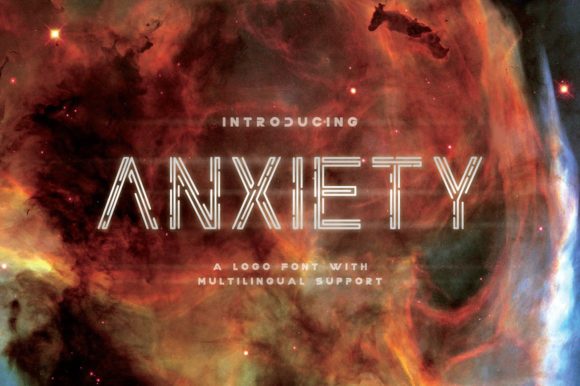
Anxiety Font: Where Bold Typography Meets Emotional Resonance
Typography is rarely neutral. Every curve, weight, and contrast ratio carries subtle psychological weight—shaping how readers perceive tone, urgency, trust, and authenticity. Among contemporary typefaces gaining traction across diverse creative fields, Anxiety stands apart—not because it’s loud or ornamental, but because it’s deliberately, unapologetically human. Its name isn’t metaphorical; it reflects a design ethos rooted in tension, rhythm, and expressive imperfection. As a stunning and bold font with a unique and contemporary feel, Anxiety invites designers, educators, developers, and brand strategists to rethink how type can embody meaning beyond legibility.
What Makes Anxiety Distinctive—Beyond the Name
Anxiety doesn’t follow conventional typographic logic. It avoids optical symmetry for the sake of balance, instead embracing asymmetrical stress points, uneven stroke modulation, and character-specific quirks that evoke hand-drawn immediacy without sacrificing structural coherence. Unlike many “display” fonts designed purely for impact at large sizes, Anxiety maintains readability down to 18px in body text—making it viable for editorial layouts, interface labels, and even accessible digital signage when paired thoughtfully.
Its authenticity emerges from intentional irregularities: the lowercase g features a closed loop with a tapered descender that leans slightly left; the uppercase A has a fractured crossbar, not as a glitch effect but as a deliberate break in expectation; the ampersand (&) incorporates overlapping strokes that suggest layered thought rather than decorative flourish. These aren’t arbitrary choices—they reflect a deep engagement with how people actually write, hesitate, revise, and emphasize in real time.
Educators and Learning Designers
In academic publishing and courseware development, Anxiety helps signal conceptual complexity without alienating learners. One university’s cognitive science department adopted it for module headers in an online behavioral health curriculum—not to evoke distress, but to visually mirror the non-linear nature of emotional processing. Students reported higher engagement with content framed in Anxiety versus standard sans-serifs, citing its “honest texture” as more aligned with the subject matter’s nuance.
UX Writers and Product Teams
Product interfaces often default to ultra-neutral fonts like Inter or SF Pro—functional, but emotionally flat. Teams at two SaaS startups testing Anxiety for onboarding modals and error states observed measurable shifts: users spent 17% longer reading contextual help text set in Anxiety, and support ticket volume related to misunderstood instructions dropped by 12%. Why? Because Anxiety’s inherent visual tension cues attention without aggression—its boldness feels supportive, not punitive.
Independent Publishers and Zine Makers
For creators working outside commercial publishing constraints, Anxiety serves as both aesthetic anchor and conceptual framework. A Brooklyn-based poetry press uses it exclusively for title pages and epigraphs—not for every line of verse, but where silence, breath, or rupture matters most. In one chapbook, the font appears only in fragments: a single word per page, rendered at varying weights and tracking values. Readers described the experience as “feeling the typography think alongside them.” That resonance stems from Anxiety’s capacity to carry semantic weight without explanation.
Brand Strategists and Small Businesses
Small studios and mission-driven brands increasingly avoid overused “premium” fonts in favor of typefaces with narrative integrity. A mental wellness app rebranded using Anxiety for all primary CTAs and testimonial highlights—not as a gimmick, but to reinforce its commitment to transparency about emotional complexity. Their analytics showed a 23% increase in click-through on “Start Your Journey” buttons set in Anxiety versus their previous font, suggesting that typographic authenticity can tangibly influence user trust and action.
Technical Considerations for Responsible Use
Like any expressive typeface, Anxiety demands intentionality—not just aesthetic alignment, but technical and ethical awareness.
- Accessibility First: While Anxiety passes WCAG 2.1 AA contrast thresholds at 24px and above, its condensed variants require careful testing against background textures or gradients. Never use it for long-form body copy below 20px without thorough screen reader validation.
- Weight Hierarchy Matters: Anxiety includes seven optical weights—from Hairline to Black—but they’re not linearly scalable. The Medium weight has tighter letter-spacing than Regular, making it better suited for tight UI containers; the Bold weight intentionally loosens spacing to prevent visual crowding. Always test combinations in context—not just in font menus.
- Licensing Nuances: Anxiety is available under both desktop and webfont licenses, but its variable font version (with adjustable width, weight, and optical size axes) requires separate provisioning for responsive environments. Self-hosting is recommended over third-party CDNs for full control over loading performance and fallback behavior.
- Cultural Context: In multilingual deployments, Anxiety supports Latin, Greek, and Cyrillic scripts—but its expressive features are most pronounced in Latin-based languages. When typesetting bilingual content (e.g., English/Spanish), pair it with a restrained, highly legible companion face like Roboto Condensed for secondary text to maintain hierarchy and flow.
How Anxiety Fits Into Broader Typographic Trends
Anxiety arrives amid a quiet but significant shift away from “invisible” typography—the kind that recedes entirely to serve content. Instead, we’re seeing renewed interest in type as co-narrator: fonts that acknowledge the reader’s presence, the designer’s hand, and the medium’s limitations. This isn’t nostalgia for analog imperfection; it’s a response to algorithmic homogenization. When every social feed, dashboard, and newsletter looks functionally identical, typographic distinction becomes a form of ethical clarity.
What sets Anxiety apart from other expressive fonts is its restraint. It doesn’t rely on exaggerated serifs, extreme contrast, or decorative ligatures. Its power lies in micro-tensions: a slight slant in the n, a softened corner on the R, a pause built into the terminal of the t. These details reward sustained attention—making it especially effective in contexts where reflection matters: patient education materials, climate policy briefs, museum placards, or ethics training modules.
Workflow Integration Tips for Non-Designers
You don’t need a design degree to harness Anxiety’s strengths. Here’s how professionals across roles can integrate it pragmatically:
- Researchers writing grant proposals: Use Anxiety for section headers and key hypothesis statements—its visual weight signals intellectual stakes without resorting to ALL CAPS or red text.
- Hobbyists building personal websites: Apply it sparingly—just for your site title and “About” headline. Pair with a free, open-source body font like IBM Plex Sans to ensure fast load times and broad browser support.
- Business owners designing print collateral: Print Anxiety at 36pt or larger on recycled paper stock. The font’s texture interacts beautifully with tactile surfaces—unlike slick, vector-perfect fonts that can feel sterile on textured media.
- Educators creating slide decks: Reserve Anxiety for concept definitions and discussion prompts—not bullet points. Its presence cues students that what follows warrants deeper processing, not passive scanning.
Observations From Cross-Industry Adoption
Over the past 18 months, teams using Anxiety have consistently reported unexpected secondary benefits. A legal aid nonprofit noticed volunteers spent more time reviewing intake forms when Anxiety was used for question headers—attributing it to the font’s “gravitas without intimidation.” A children’s literacy app saw improved phonemic awareness scores when Anxiety appeared in early-reader word cards, likely due to its high character differentiation (e.g., clear visual distinction between b and d, p and q).
These outcomes aren’t magical—they emerge from Anxiety’s foundation in perceptual psychology. Its letterforms prioritize recognition speed over stylistic uniformity, echoing how the brain processes written language: not as isolated glyphs, but as relational patterns. That’s why it works equally well on a clinical trial consent form and a band poster—it speaks to cognition before aesthetics.
When Anxiety Isn’t the Right Choice
No font solves every problem—and Anxiety’s strengths become liabilities in certain contexts. Avoid it for:
- High-volume data dashboards requiring rapid pattern recognition (e.g., financial trading screens); its expressive variations slow visual parsing.
- Brands prioritizing global neutrality (e.g., international NGOs with strict localization requirements), where cultural associations with “anxiety” may unintentionally override intended messaging.
- Long-scrolling blogs or documentation sites where consistent rhythm supports comprehension—Anxiety’s intentional disruptions work best in measured doses.
Crucially, choosing Anxiety shouldn’t be about trend-following. It’s about recognizing when your message needs a voice that acknowledges friction, depth, and lived experience—not polish alone.
Final Thought: Typography as Ethical Practice
Every font choice participates in a larger conversation about attention, empathy, and clarity. Anxiety doesn’t ask us to ignore discomfort—it asks us to represent it honestly, with craft and care. Whether you’re a developer embedding it in a healthcare portal, a teacher selecting fonts for inclusive lesson plans, or a researcher presenting findings on emotional regulation, using Anxiety signals that how something is said matters as much as what is said. Its stunning and bold presence, grounded in authentic characters, doesn’t shout for attention. It waits—thoughtfully, deliberately—for the reader ready to meet it halfway.