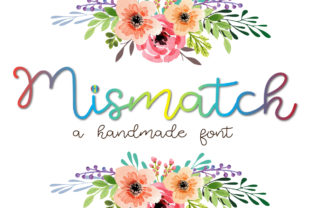
Mismatch: Handwritten Charm That Feels Like a Smile on Paper
There’s a quiet magic in fonts that don’t try too hard—ones that lean, loop, and linger just a little longer than expected. Mismatch is exactly that kind of typeface: a playful, detailed handwritten font built not for perfection, but for personality. It doesn’t shout—it winks. And whether you're sketching a logo at 2 a.m., designing a wedding invite, or adding warmth to a Shopify banner, Mismatch brings youthful charm without sacrificing legibility or intention.
What Makes Mismatch More Than Just “Cute”?
At first glance, Mismatch looks like someone’s joyful penmanship—slightly uneven baselines, varied letter heights, and expressive strokes that mimic real ink on paper. But look closer: every curve is deliberate, every connection thoughtful. Unlike generic script fonts that blur into sameness, Mismatch balances spontaneity with structure. Its lowercase ‘g’ has a whimsical tail; the uppercase ‘Q’ ends in a soft flick; the ‘s’ sways with gentle confidence.
This isn’t accidental charm—it’s engineered expressiveness. The designers behind Mismatch studied how handwriting breathes: where pressure builds, where speed lifts the pen, how rhythm changes mid-word. The result? A font that feels human—not because it’s messy, but because it remembers what it’s like to write with joy.
Key Characteristics That Set It Apart
- Playful inconsistency: Letters vary subtly in weight and slant—no two ‘a’s are identical, echoing natural handwriting without sacrificing cohesion.
- Rich OpenType features: Includes alternate characters, ligatures, and contextual swashes that activate automatically (in compatible software), letting words flow more organically.
- Warm, approachable x-height: Tall lowercase letters improve readability at smaller sizes—ideal for body text in editorial layouts or product packaging.
- Thoughtful spacing: Kerning is tuned for rhythm, not rigidity—so “hello” and “forever” both feel balanced, not cramped or stretched.
Where Does Mismatch Shine—and Where Might It Pause?
Mismatch thrives where authenticity matters more than austerity. It’s not meant for legal disclaimers, flight departure boards, or dense academic footnotes—but it excels in spaces where tone and trust go hand-in-hand.
Real-World Uses That Feel Effortlessly Right
- Craft brands & small-batch makers: A ceramicist labeling mugs, a candle company naming scents (“Honey & Rain”, “Pine + Paper”), or a local bakery stamping brown bags—all benefit from Mismatch’s tactile warmth. It signals care, not calculation.
- Personalized stationery: Wedding suites, baby announcements, or thank-you notes gain intimacy when set in Mismatch. Its slight irregularity mirrors the uniqueness of each life moment.
- Digital storytelling: Blog headers, Instagram quote graphics, or Substack newsletter banners become more inviting—readers subconsciously relax when typography feels unhurried and kind.
- App interfaces & micro-interactions: Used sparingly (e.g., celebratory success messages or onboarding tips), Mismatch adds emotional texture without compromising usability.
That said, Mismatch asks for context-awareness. It’s not a workhorse for data tables or multilingual UIs with complex scripts. Its Latin character set is robust—but it doesn’t support Cyrillic, Arabic, or extended Vietnamese diacritics. If your project requires broad language coverage or ultra-high-density information display, pair Mismatch with a clean sans-serif for contrast and clarity.
Who Benefits Most From Using Mismatch?
The answer isn’t about job titles—it’s about intent.
Creatives who lead with feeling: Illustrators, lettering artists, and indie designers often reach for Mismatch when they want typography to echo their hand-drawn aesthetic—without redrawing every word.
Small business owners building identity: You don’t need a branding agency to convey sincerity. With Mismatch, a single font can anchor your visual voice across social posts, email signatures, and printed tags—consistently warm, never generic.
Educators and community organizers: Handouts, workshop handbooks, or neighborhood event flyers gain approachability. Children’s literacy materials, in particular, respond well to Mismatch’s friendly forms—studies suggest familiar, rounded handwritten styles support early reading fluency.
Content creators focused on connection: Podcast show notes, Patreon update headers, or Notion dashboards feel more personal when key phrases (“You’re almost there”, “Let’s begin”) are set in Mismatch. It quietly says, “I made this for you—not for algorithms.”
Practical Tips for Getting the Most Out of Mismatch
Like any expressive tool, Mismatch rewards thoughtful use—not just installation.
- Size matters—and so does spacing: At 16–24px, Mismatch reads beautifully as display text. For body copy, aim for 20px minimum with generous line height (1.5–1.7). Avoid tight tracking—let those letters breathe.
- Pair with restraint: Combine with neutral, highly legible fonts like Inter, Lato, or even Georgia. Avoid other decorative or script fonts—they’ll compete, not complement.
- Test across devices: While Mismatch renders well on modern browsers and design apps, always preview on mobile. Some swash variants may simplify on smaller screens—use them intentionally, not by accident.
- Leverage its alternates: In Adobe apps or via CSS
@font-feature-settings, enable stylistic sets to swap in flourishes for headings or soften tone in longer paragraphs.
A Note on Licensing & Accessibility
Mismatch is typically offered under clear desktop, web, and app licenses—always verify terms before embedding in SaaS products or client deliverables. While its friendly shape supports readability for many, remember that true accessibility goes beyond aesthetics: ensure sufficient color contrast (at least 4.5:1 against backgrounds), provide alt text for image-based uses, and avoid relying solely on Mismatch for critical navigation labels.
Is Mismatch Right for Your Next Project?
Ask yourself three questions:
- Does this project benefit from warmth over formality? If yes, Mismatch is likely a strong fit.
- Will readers spend time with this text—or just scan it? Use Mismatch for moments meant to be felt, not rushed.
- Do you have control over presentation context? Because Mismatch shines in curated spaces (print, controlled web layouts, branded assets), it works best when you’re not handing it off to third-party platforms with unpredictable rendering.
If two out of three resonate, give Mismatch a try—not as decoration, but as intention made visible. Try setting your project’s core value statement in it. Or rewrite your tagline with its natural rhythm. You’ll know within seconds whether it fits—not because it looks “on-brand,” but because it feels like the right voice showing up, exactly when needed.
In a digital world saturated with uniformity, Mismatch reminds us that the most memorable communication doesn’t strive to be flawless—it strives to be felt. And sometimes, the most professional choice is the one that dares to doodle.