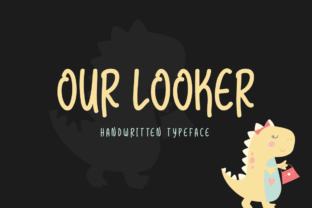
Our Looker: A Handwritten Font That Feels Like It Was Made for Your Next Project
If you’ve ever spent 20 minutes scrolling through font libraries—only to land on something that’s either too stiff, too trendy, or just *not quite right*—you’ll recognize the quiet relief of finding Our Looker. It’s not another overdesigned script meant for one-off social posts. It’s a modern handwritten font built with intention: warm but clear, expressive but legible, personal but professional. And it works where most handwritten fonts stumble—on t-shirts that need to hold up in washes, on printed stationery that sits on desks for months, and on website headers that load fast and read well on both phones and desktops.
Where Our Looker Fits Naturally (Without Forcing It)
Unlike fonts that demand attention, Our Looker earns its place by fitting into real workflows—not just design mockups. Think about the small business owner printing wedding invites: they don’t want to wrestle with ligatures or inconsistent spacing. They need a font that looks hand-lettered at a glance but prints cleanly on matte cardstock. That’s where Our Looker delivers—its letterforms have gentle variation (no robotic repetition), yet its baseline alignment and x-height are tuned for consistency across sizes.
Or consider the educator designing a classroom poster for a science unit on ecosystems. She’s not a designer—but she knows her students respond better to friendly, approachable visuals. With Our Looker, she can type “Food Chains Start Here” in a large header, pair it with simple sans-serif body text, and get instant warmth without needing to trace or edit glyphs. No extra software. No learning curve. Just clarity with character.
Real Uses—Not Just “Great For…” Lists
Here’s how people actually use Our Looker, based on early feedback from creators and small teams:
- Small-batch product labels: A candle maker uses Our Looker for scent names (“Honey & Rain”, “Pine + Paper”) on kraft stickers. The slight ink-like texture reads as artisanal—not digital—and scales down to 10pt without blurring.
- Music cover art: An indie folk artist drops a new EP and builds the cover in Canva. Instead of defaulting to a generic script, they drop in Our Looker for the title. Fans comment that it “feels like the album sounds”—soft, intentional, human-scaled.
- Print-on-demand merch: A freelance illustrator adds short quotes to t-shirt mockups. With Our Looker, the text doesn’t vanish under screen-print halftones. Its open counters and balanced weight keep letters readable even after fabric shrinkage or dye migration.
- Photo frames & wall prints: A parent orders a custom print of their child’s handwritten note (“I love you more than cookies”). They retype it in Our Looker—not to mimic handwriting exactly, but to echo its sincerity. The result feels personal, not AI-generated.
- Website headers & hero sections: A yoga studio updates its homepage. Instead of a stocky serif or a fragile calligraphy font, they use Our Looker at 48px for the headline “Breathe In. Begin Again.” It loads instantly, renders crisply on Safari and Chrome, and pairs effortlessly with Inter or Open Sans below.
Why It Works Where Other Handwritten Fonts Don’t
Most handwritten fonts fall into two traps: either they’re overly uniform (losing all sense of gesture) or wildly irregular (making them unusable for anything longer than three words). Our Looker walks the line deliberately. Its lowercase a, g, and y have subtle alternate forms—but only when context supports them (like in OpenType-aware apps). In basic editors like Google Docs or Canva, it defaults to its most stable, readable set. That means you get personality *without* unpredictability.
It’s also kerned for real-world spacing—not theoretical perfection. Letters like “To”, “Va”, and “Fr” sit comfortably next to each other, so you’re not constantly adjusting tracking for flyers or posters. And because it’s designed with web use in mind, the WOFF2 version is lean (<120KB), so your site’s typography doesn’t drag down Core Web Vitals.
Who Benefits Most—and How
Freelancers who juggle branding, social graphics, and client deliverables appreciate that Our Looker serves multiple roles: a logo lockup font, a quote overlay for Instagram carousels, and clean headings for pitch decks—all from one file. No need to license three different scripts.
Educators and nonprofit staff often work with tight budgets and limited design support. Our Looker gives them an easy upgrade path from default fonts—no training required. One middle school librarian told us she used it for her “Summer Reading Bingo” board, and kids immediately said, “Miss T, did *you* write this?” That’s the effect: authenticity, not artifice.
Hobbyists and makers value flexibility. Whether you’re laser-cutting wooden coasters, embroidering tote bags, or designing a zine layout in Affinity Publisher, Our Looker holds up. Its vector outlines stay sharp at any size, and its modest contrast (not too thin, not too bold) ensures readability whether stitched, etched, or printed.
Things to Keep in Mind Before You Use It
Like any tool, Our Looker shines brightest when matched to the right job. It’s not ideal for dense body text—stick to 16–20pt max for readability in long paragraphs. And while it includes basic Latin characters and common punctuation, double-check support for accented letters if you’re creating bilingual materials (it covers Spanish, French, German, and Portuguese diacritics—but not extended Cyrillic or Arabic).
Also, remember: handwriting fonts gain impact through restraint. Using Our Looker for every heading, button, and caption dilutes its charm. Try reserving it for moments where you want to signal care, craft, or connection—like a welcome message, a signature line, or a tagline above a product photo.
Finally, test it where it lives. Paste a sample into your email newsletter template. Preview it on your phone’s browser. Print a flyer draft on your home printer. Our Looker was made to perform—not just impress in a font preview window.
If you’ve been avoiding handwritten fonts because they felt unreliable, inconsistent, or hard to integrate, Our Looker is worth trying—not as a trend, but as a practical, quietly confident choice for projects that matter to real people.