Sincerely Yours: Where Handwritten Warmth Meets Modern Design
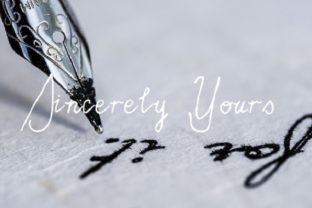
There’s a quiet shift happening across digital and print design—one measured not in pixels or algorithms, but in pen strokes. People aren’t just seeking clarity or speed anymore; they’re craving authenticity, humanity, and subtle emotional resonance. That’s where Sincerely Yours steps in—not as a trend-chasing novelty, but as a thoughtful response to how we communicate today. It’s a beautiful and delicate handwritten font that will put a unique spark on any design project, precisely because it doesn’t shout. It leans in.
A Font That Feels Like a Thoughtfully Written Note
Sincerely Yours isn’t mimicking calligraphy or miming brushwork. It’s carefully crafted to reflect the natural variation of real handwriting—the slight taper of an ascending stroke, the gentle hesitation before a curve, the soft lift between letters. There are no rigid uniformities, no mechanical repetitions. Instead, you’ll notice organic spacing, nuanced line weights, and a rhythm that breathes. That’s intentional. In an era saturated with ultra-polished, algorithmically optimized interfaces, this kind of human imperfection reads as trustworthy, approachable, and quietly confident.
Unlike many script fonts that prioritize flourish over function, Sincerely Yours balances expressiveness with legibility—even at smaller sizes and in longer passages. Its lowercase ‘a’, ‘g’, and ‘y’ avoid excessive loops or tangles, and its letterforms maintain consistent x-height and baseline alignment. That means it works not only in a wedding invitation or boutique logo but also in a heartfelt email signature, a teacher’s classroom handout, or a small-batch product label.
Why Handwritten Typography Is Gaining Ground—Beyond Aesthetics
This isn’t about nostalgia for inkwells or cursive drills. It’s about alignment with deeper behavioral and cultural shifts. Consider how communication habits have changed: more messages are sent—but fewer feel personal. Automated replies, templated newsletters, and AI-generated content dominate inboxes and feeds. As a result, audiences subconsciously assign higher value to anything that signals intentionality and care.
Brands and creators are noticing. A local bakery doesn’t need a corporate sans-serif to convey warmth—it needs typography that echoes the chalkboard menu written by hand each morning. An educator designing a welcome packet for new students might choose Sincerely Yours to soften the institutional tone without sacrificing professionalism. A freelance writer launching a personal newsletter could use it in headers to signal voice-first storytelling—not algorithm-first optimization.
Even user experience (UX) designers are integrating handwritten elements more thoughtfully—not as decorative flourishes, but as strategic tonal cues. A delicate script like Sincerely Yours can act as visual punctuation: guiding attention, easing transitions between sections, or signaling a moment of reflection amid denser content.
From Trend to Tool: Practical Use Cases That Stick
What separates Sincerely Yours from fonts that fade after one seasonal campaign is its adaptability across real-world constraints. Here’s how professionals are using it—not as a gimmick, but as part of a considered toolkit:
- Brand identity systems: Paired with a clean, neutral sans-serif (like Inter or Lato), Sincerely Yours creates contrast without conflict—ideal for service-based businesses, wellness practitioners, or creative studios wanting to balance expertise with empathy.
- Digital touchpoints: Used sparingly in hero headers, CTA buttons (“Let’s begin”), or testimonial quotes, it adds warmth without compromising load time or accessibility—especially when served as a variable font or subsetted for web use.
- Educational materials: Teachers report improved student engagement when using Sincerely Yours in handouts or slide titles—particularly for reflective prompts, journaling guides, or social-emotional learning resources.
- Print collateral with purpose: Wedding stationery, artisan packaging, and limited-edition zines benefit from its tactile sensibility. Because it avoids over-decoration, it scales gracefully from business card to poster size.
Crucially, it performs well across platforms. When exported as SVG or embedded via modern web font protocols, Sincerely Yours renders consistently in browsers, email clients, and design tools—including Figma, Adobe Creative Cloud, and Canva (with custom upload). No plugins required. No rendering surprises.
Not Just for “Creative” Projects—A Strategic Choice
Some assume handwritten fonts belong only to lifestyle brands or hobbyist projects. But look closer: healthcare providers use them in patient onboarding emails to reduce anxiety. Financial advisors apply them in personalized summary reports to soften complex data. Nonprofits embed them in donor thank-you notes to reinforce sincerity—not salesmanship.
That’s the functional power of Sincerely Yours: it supports intent. If your goal is to build rapport, acknowledge individuality, or invite reflection, the font becomes part of the message—not just its container. It doesn’t replace strategy; it reinforces it.
What’s Changed—and What Hasn’t
Handwritten fonts have existed for decades, but earlier versions often suffered from technical limitations—poor hinting, inconsistent kerning, or overly stylized forms that broke down outside ideal conditions. Today’s iteration of Sincerely Yours reflects advances in font engineering: OpenType features like contextual alternates, stylistic sets, and ligatures allow subtle variations that mimic natural writing flow—without manual intervention.
At the same time, expectations have matured. Designers no longer ask, “Does it look nice?” They ask, “Does it serve the audience? Does it scale? Does it respect accessibility norms?” Sincerely Yours answers yes—when used intentionally. It’s not meant for body text at 12px on mobile, nor for legal disclaimers requiring maximum legibility. But within its thoughtful scope, it delivers reliably.
Getting Started—Without Overcomplicating It
You don’t need a branding overhaul to begin. Start small:
- Use Sincerely Yours for a single, high-impact element—like the headline in your next blog post or the name on your portfolio thumbnail.
- Pair it deliberately: let it shine against generous whitespace and a restrained color palette. Avoid competing scripts or overly busy backgrounds.
- Test readability early: preview on both desktop and mobile, and ask someone unfamiliar with the project to read a sample aloud.
- Respect hierarchy: if using it for headings, choose a complementary typeface with clear contrast in weight, proportion, and tone for body copy.
And remember—authenticity isn’t performative. Using Sincerely Yours won’t magically make your brand “warm” if your messaging or actions contradict that tone. The font amplifies what’s already there. It’s a collaborator, not a fix.
A Quiet Counterpoint in a Loud World
Design tools grow more powerful every year. AI can generate layouts, suggest palettes, even draft copy. Yet the most resonant work still begins with human judgment—what to emphasize, where to pause, how to make someone feel seen. Sincerely Yours doesn’t replace that judgment. It honors it.
It’s a reminder that technology serves people—not the other way around. That efficiency shouldn’t erase nuance. That even in fast-moving workflows, a deliberate choice—like selecting a font that feels like a handwritten note—can anchor a project in something enduring: care, clarity, and quiet confidence.
So whether you’re launching a side hustle, redesigning a course syllabus, or simply choosing how to sign off an important message—consider what tone you want to carry. Not just what you say, but how it lands. With Sincerely Yours, it lands gently—and stays remembered.