The Blackport Family: A Strategic Choice for Distinctive Visual Identity
Typography isn’t just about legibility—it’s a quiet but decisive signal of intent. The Blackport Family stands apart not because it’s trendy, but because it carries a coherent, intentional aesthetic: vintage authenticity paired with handmade warmth. It’s a font duo—typically one serif and one complementary script or display face—designed to work in concert, not competition. When applied thoughtfully, The Blackport Family supports strategic goals like brand differentiation, emotional resonance, and audience alignment far more effectively than generic alternatives.
Why This Duo Fits Real-World Planning—and Why It Doesn’t Fit Everything
The Blackport Family excels where character matters more than neutrality. Think artisanal food packaging, independent book covers, boutique studio letterheads, or handcrafted product labels. Its subtle irregularities—slight variations in stroke weight, gentle ink bleed effects, and organic baseline shifts—signal human effort and care. That’s valuable when your positioning rests on authenticity, heritage, or craft. But that same quality becomes a liability in contexts demanding precision, scalability, or universal clarity: technical documentation, data dashboards, legal disclaimers, or multilingual interfaces where glyph consistency is non-negotiable.
Before selecting The Blackport Family, ask: What outcome am I trying to produce? If the goal is to evoke trust through familiarity and warmth—say, for a local bakery’s seasonal menu or a ceramicist’s online shop—it aligns well. If the goal is rapid scanning across devices or conveying authority in a corporate report, it likely won’t serve you.
Strategic Pairing: How to Use The Blackport Family Without Compromising Function
Using The Blackport Family intentionally starts with hierarchy—not decoration. Its strength lies in contrast: the serif face provides structure and readability for body text or headings; the script or display companion adds personality for logos, pull quotes, or limited accent use. Avoid stacking both faces in equal visual weight. Instead:
- Use the serif for all functional text—captions, descriptions, instructions—where clarity and rhythm matter most.
- Reserve the script for single-line applications: a logo lockup, a chapter title, or a signature stamp. Never use it for paragraphs or small sizes.
- Test at real-world sizes: what reads beautifully at 48pt on a poster may vanish at 14pt on mobile. Prioritize legibility over charm in functional contexts.
- Pair with neutral, highly legible typefaces (e.g., a clean sans-serif) for supporting text—never force The Blackport Family to do double duty.
This approach prevents visual fatigue and preserves impact. Overuse dilutes distinction; disciplined use makes every appearance meaningful.
Illustrations and Logos: Extending the System, Not Just Decorating It
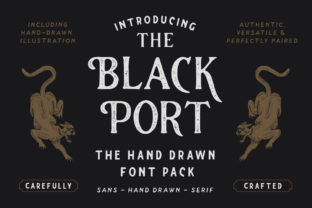
The Blackport Family includes more than fonts—it ships with a curated set of illustrations and logo elements. These aren’t generic clipart. They’re stylistically matched: line weights echo the serif’s serifs; curves mirror the script’s flow; textures suggest the same paper grain or ink absorption. Used together, they form a cohesive visual language—not a grab bag of assets.
That cohesion delivers practical value. For a small business owner designing their own social media banners, having matching icons and borders means faster iteration without sacrificing consistency. For an educator creating printable worksheets on historical themes, the vintage feel reinforces context without requiring custom illustration. But here’s the strategic caveat: these assets only strengthen your message if they support your core narrative. A coffee roaster using The Blackport Family’s floral motifs works—if their brand story emphasizes origin, seasonality, and hand-picking. Using the same motifs for a cybersecurity consultancy would create dissonance, not distinction.
Risks of Context-Free Adoption
Like any strong stylistic tool, The Blackport Family carries risks when divorced from purpose. The most common missteps include:
- Assuming “vintage” equals “timeless.” Some vintage aesthetics age poorly—or worse, unintentionally evoke outdated values. Review each illustration and typographic nuance for cultural resonance, not just visual appeal.
- Ignoring accessibility implications. Script faces often fail WCAG contrast and readability standards. Never rely on The Blackport Family’s script alone for essential information—always provide accessible alternatives (e.g., alt text, fallback typography, or simplified versions).
- Over-indexing on aesthetics at the expense of usability. A beautifully typeset invoice using The Blackport Family’s script for amounts may look elegant—but slow down payment processing or increase support queries. Function must anchor form.
- Forgetting scalability. Hand-drawn textures and fine details degrade across formats. Test how logos render on favicons, embroidery, or large-format signage before finalizing.
These aren’t reasons to avoid The Blackport Family—they’re reasons to engage with it deliberately. Every design decision should answer: Does this serve the user’s need, the brand’s promise, and the medium’s constraints—simultaneously?
Long-Term Value: Building Recognition, Not Just Rendering
Brands that endure rarely chase trends—they cultivate recognition through consistency and intention. The Blackport Family supports that when used as part of a broader system: consistent spacing, restrained color palettes, thoughtful illustration usage, and clear typographic roles. Over time, audiences begin to associate its warmth and texture with reliability in specific contexts—like recognizing a favorite café by the weight of its menu paper and the curve of its chalkboard sign.
That kind of recognition compounds. It reduces cognitive load for repeat visitors. It builds implicit trust. And it gives you permission to evolve—because the foundation is clear, not chaotic. You can introduce new photography styles, update layouts, or refine messaging—all while keeping The Blackport Family as a steady, recognizable thread.
Practical Next Steps for Intentional Use
If The Blackport Family fits your current goals, start small and scale deliberately:
- Begin with one high-impact application: Redesign your email signature or homepage headline using the serif + script pairing. Measure engagement changes—not just clicks, but time-on-page and scroll depth.
- Document your rationale: Write down why you chose it for that use case. Revisit that note before expanding to other touchpoints. Does the reasoning still hold?
- Build a micro-style guide: Define exact point sizes, line heights, color values, and illustration usage rules—even if it’s just two paragraphs long. Consistency emerges from constraint, not chance.
- Test with real users: Show two versions of a landing page—one with The Blackport Family, one with a neutral alternative. Ask open-ended questions: “What does this make you assume about the company?” “What feels trustworthy here—and what feels unclear?”
Typography choices compound over time. A rushed selection might save ten minutes today but cost hours in rework later. The Blackport Family rewards patience—not as a decorative flourish, but as a considered component of your communication architecture.
Final Observation: Tools Serve Strategy, Not the Reverse
The Blackport Family is not a solution looking for a problem. It’s a precise instrument—valuable when the task calls for warmth, tactility, and human-scaled distinction. Its power grows not from how many elements it includes, but from how clearly you define where and why those elements belong. That clarity doesn’t come from the font itself. It comes from you: your goals, your audience, your constraints, and your willingness to edit as rigorously as you design.