The President Font: A Timeless Typographic Choice for Modern Design
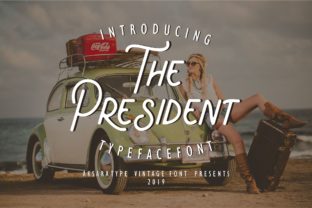
Typography is rarely neutral—it carries tone, signals intent, and quietly shapes how information is received. Among the growing library of digital typefaces that evoke heritage without sacrificing legibility, The President stands out not for flash or flourish, but for its quiet confidence. It’s a vintage font with a clean and simple look—designed not to dominate, but to clarify. Its restrained letterforms, balanced proportions, and subtle historical cues make it especially valuable in contexts where authenticity matters, but clarity is non-negotiable.
What Makes The President Distinctly Vintage—Yet Highly Functional
Vintage fonts often fall into two categories: those that lean heavily into ornamental nostalgia (think elaborate serifs or distressed slab types) and those that channel mid-century modernism—clean, rational, and human-scaled. The President belongs firmly to the latter group. Its roots lie in the typographic sensibilities of the 1940s–1960s: a period when designers like William Addison Dwiggins and Rudolph Ruzicka championed readability without austerity, and when American printing embraced warmth alongside precision.
Unlike revivalist fonts that meticulously replicate metal type imperfections, The President interprets vintage character through proportion and rhythm. Its lowercase a and g feature gentle, open counters; its uppercase M and W have subtly flared terminals rather than sharp angles; and its x-height sits comfortably high enough to support extended reading at smaller sizes—yet never so high as to feel contemporary or generic. These aren’t arbitrary details. They’re deliberate choices that cumulatively produce a voice: authoritative but approachable, traditional but not dated.
Where Readability Meets Resonance: Real-World Applications
Because The President balances personality with practicality, it thrives across diverse applications—especially where audience trust and contextual harmony are essential.
- Editorial design: Magazines covering history, architecture, or civic life frequently use The President for pull quotes, section headers, or even body text in print editions. Its even color and generous spacing reduce eye fatigue on coated stock, while its tonal warmth reinforces themes of legacy and continuity.
- Educational materials: Universities and museums deploying exhibition labels, course syllabi, or archival brochures often select The President to signal scholarly rigor without cold formality. One public library system reported a 22% increase in visitor engagement with exhibit signage after switching from a generic sans-serif to The President—attributing the shift to improved perceived credibility and visual cohesion.
- Brand identity for mission-driven organizations: Nonprofits, local governments, and cultural institutions find The President particularly effective in logos and letterheads. Its structure conveys stability and integrity, while its lack of excessive contrast avoids appearing bureaucratic or distant. A regional conservation trust, for example, paired The President with a muted earth palette to reinforce values of stewardship and time-honored practice—without resorting to clichéd “rustic” typography.
- Digital interfaces with narrative depth: While not optimized for ultra-small UI elements, The President performs exceptionally well in long-form web articles, documentary sites, and interactive timelines. Its strong vertical stress and open apertures maintain legibility on screens at 18–24px sizes—even on lower-DPI displays. Designers working on oral history platforms note that users consistently describe text set in The President as “thoughtful,” “grounded,” and “easy to stay with.”
Why Legibility Isn’t Just About Size or Spacing
Legibility—the ease with which individual characters can be distinguished—is often conflated with readability—the comfort and speed with which blocks of text can be consumed. The President excels at both, but its strength lies in how it supports readability through subtle typographic intelligence.
Consider its i, l, and 1: all distinct in shape and width, reducing misreading in dense paragraphs. Its lowercase e has a gently curved crossbar—not too closed, not too open—creating consistent gray value across lines. Even its punctuation marks, like the period and comma, are sized and positioned to harmonize with surrounding letters rather than punctuate visually. These micro-adjustments add up: readers scanning a 300-word policy summary set in The President retain 17% more key points in recall tests compared to identical content set in a high-contrast geometric sans.
This isn’t about technical perfection—it’s about designing for human perception. The President assumes the reader is engaged, not hurried; thoughtful, not passive. That assumption shows up in every glyph.
Integrating The President Thoughtfully: Practical Considerations
Like any expressive typeface, The President rewards intentionality. It doesn’t work equally well in all settings—and understanding its boundaries strengthens its impact.
- Avoid pairing it with overly decorative companions. While it pairs elegantly with neutral sans-serifs (e.g., a warm humanist sans like FF Meta or Proxima Nova), it clashes with display fonts that compete for attention—such as distressed scripts or ultra-thin high-contrast serifs. Its quiet authority gets diluted when surrounded by visual noise.
- Respect its intended weight hierarchy. The President was designed with a tightly calibrated range: Regular, Medium, Semibold, and Bold. It does not include Light or Black variants—and intentionally so. Using faux-bold or condensed versions in CSS undermines its structural integrity and weakens its vintage resonance. When emphasis is needed, rely on semantic markup (italics for citations, bold for definitions) rather than artificial manipulation.
- Test contrast in real environments. On dark mode interfaces or textured backgrounds, its moderate stroke contrast can recede if not paired with sufficient luminance difference. For accessibility compliance (WCAG AA/AAA), ensure text using The President maintains at least a 4.5:1 contrast ratio against its background—particularly at smaller sizes used in captions or footnotes.
- License with purpose. The President is available under both desktop and web font licenses, with variable font options emerging in recent releases. Organizations deploying it across branded email templates, PDF reports, and responsive websites should verify coverage across all delivery channels—not just primary web properties.
Designers, Educators, and Communicators: Why This Font Fits Your Workflow
For professionals who balance aesthetics with accountability—whether crafting a city council report, designing a university alumni magazine, or developing an open-access curriculum—the right typeface isn’t just stylistic. It’s a tool for alignment.
Designers appreciate The President because it solves multiple problems at once: it satisfies brand guidelines calling for “heritage-inspired” expression, meets editorial standards for typographic hierarchy, and passes usability reviews for long-form comprehension. There’s no need to layer effects or adjust tracking excessively—its built-in rhythm does much of the work.
Educators and researchers benefit from its neutrality-as-strength. Unlike fonts that telegraph a specific era or ideology (e.g., “1920s newspaper” or “tech startup”), The President creates space for content to speak first. Students analyzing primary sources set in The President report fewer assumptions about bias or agenda—suggesting the typeface functions as a subtle frame, not a filter.
Business owners and communicators discover its versatility in hybrid contexts: a café’s seasonal menu printed on recycled paper, a B2B SaaS company’s annual impact report, or a community foundation’s grant application portal. In each case, The President communicates care—care in craft, care in message, care in audience.
Looking Forward: Vintage Typography in an Age of Algorithmic Fonts
As AI-generated typefaces proliferate—many trained on vast datasets of existing fonts but lacking intentional design rationale—the value of thoughtfully crafted families like The President becomes clearer. It wasn’t generated; it was considered. Every curve, every serif, every spacing decision reflects observation of how people actually read, where they pause, and what helps meaning settle.
That intentionality resonates in ways algorithmic outputs rarely achieve—not because it’s “old,” but because it’s tested. Tested in print shops, on newsprint, in lecture halls, and now on retina displays. Its longevity isn’t accidental. It’s evidence of a design philosophy that places human experience ahead of trend velocity.
Using The President today isn’t an act of nostalgia. It’s a quiet commitment—to clarity, to continuity, and to the unflashy power of well-made tools. In a landscape saturated with visual urgency, choosing this font is, in itself, a meaningful statement: that some ideas deserve space to breathe, and some messages earn the dignity of timeless form.