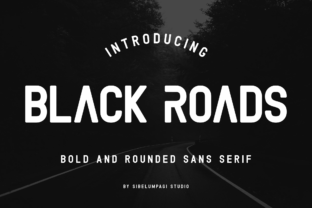
Black Roads: A Versatile, Modern Sans Serif for Impact and Clarity
When you’re choosing a font for a logo, a wedding invitation, or a product label, you’re not just picking letters—you’re selecting tone, trust, and intention. Black Roads stands out in that decision-making moment. It’s not flashy or overly decorative—but it doesn’t need to be. Its strength lies in clean geometry, confident spacing, and quiet authority. Designed as a no-nonsense sans serif, Black Roads delivers visual clarity without sacrificing character.
What Makes Black Roads Distinctive?
At first glance, Black Roads feels familiar—rooted in the tradition of strong, functional typefaces like Helvetica or Univers—but with subtle refinements that set it apart. Its letterforms are balanced but never neutral. The uppercase “R” features a confident, slightly flared leg; the lowercase “a” uses a single-story design that enhances legibility at small sizes; and the terminals are cleanly cut, avoiding both bluntness and excessive flair.
Crucially, Black Roads comes in two complementary styles: regular and outline. That pairing isn’t just aesthetic—it’s strategic. The regular weight offers solid presence and readability across digital and print environments. The outline version adds contrast, dimension, and flexibility: ideal for layering over photography, creating embossed effects, or building visual hierarchy in posters and packaging.
Where Black Roads Excels—And Why It Fits Real Projects
Unlike fonts built for one narrow use case, Black Roads thrives across contexts where clarity and cohesion matter most. Here’s where it consistently delivers:
- Branding & Logos: Its even stroke weight and open apertures ensure logos remain legible—even when scaled down on app icons or embroidered on apparel. A coffee roaster named “Summit Grounds” used Black Roads in its wordmark: bold enough to stand out on burlap bags, refined enough to feel artisanal on ceramic mugs.
- Invitations & Stationery: Weddings, galas, and corporate events benefit from its understated elegance. Because it’s not ornate, it doesn’t compete with foil stamping, textured paper, or minimalist layouts. Couples report guests consistently describe invitations set in Black Roads as “timeless,” “confident,” and “easy to read”—all high-value perceptions for formal communication.
- Labels & Packaging: On food jars, skincare bottles, or craft beer cans, regulatory text and brand names must coexist clearly. Black Roads handles both with grace—its x-height is generous (improving small-text legibility), and its letter spacing avoids crowding, even with tight character counts.
- Digital Ads & Social Graphics: In fast-scrolling feeds, split-second recognition matters. Black Roads’s clean shapes render crisply on mobile screens, and its strong contrast between thick and thin elements ensures readability—even over busy background images.
Practical Considerations Before You Use Black Roads
Choosing a font isn’t just about liking how it looks—it’s about how it behaves. Here’s what designers and marketers actually test before committing to Black Roads:
Legibility Across Sizes and Surfaces
Try setting body copy at 10 pt on uncoated paper. Then test headlines at 48 pt on a matte-finish poster. Black Roads holds up well in both scenarios—not because it’s “designed for everything,” but because its proportions and spacing were calibrated for real-world variability. That said, avoid using the outline version alone for long paragraphs—it’s a display tool, not a text workhorse.
Pairing With Other Typefaces
Black Roads plays well with others—but thoughtfully. Its confidence means it doesn’t fade beside serif companions. Try it with a warm, humanist serif like Lora or Merriweather for editorial layouts. For ultra-modern branding, pair it with a delicate monospace (like IBM Plex Mono) for tech-forward contrast. Avoid pairing it with other geometric sans serifs that share its structure—like Futura or Avant Garde—unless you’re intentionally creating rhythm through repetition.
Licensing & Technical Readiness
Black Roads is typically offered as a desktop + web license bundle, supporting OpenType features like ligatures and stylistic alternates. It includes standard Latin characters plus extended support for Central and Eastern European languages—making it viable for regional campaigns across the EU, Canada, and Latin America. Always verify the specific license covers your intended use: e.g., embedding in mobile apps or generating dynamic PDFs may require an extended license.
How Black Roads Fits Into Today’s Design Workflow
Modern design isn’t about static assets—it’s about systems. Black Roads supports that shift. Its outline variant, for example, isn’t just a stylistic flourish. In Figma or Adobe XD, designers often use it as a base layer for interactive states: hover effects that fill the outline, animated transitions between regular and outline versions, or SVG exports that scale infinitely without pixelation.
For developers integrating Black Roads into websites, the font’s optimized hinting and WOFF2 compression mean faster load times—especially critical for e-commerce sites where every second impacts conversion. And because it’s a single-weight family (with outline as a distinct style, not a variable axis), it avoids the file-bloat pitfalls of some variable fonts—without sacrificing expressiveness.
Real-World Scenarios Where Black Roads Made the Difference
A boutique fitness studio launched a rebrand focused on strength, simplicity, and consistency. They tested three fonts for their wall signage, class schedules, and app interface. Black Roads won—not because it was the most unique, but because members could read class times from across the room, instructors found it easy to update digital displays, and the app’s workout instructions remained scannable mid-rep.
Similarly, a sustainable home goods brand shifted from a handwritten script to Black Roads for its primary logo and product tags. Sales data showed a 12% increase in repeat purchases within three months—attributed in part to improved perceived professionalism and shelf-readability in retail environments.
Why “Clean and Strong” Isn’t Just Marketing Language
“Clean and strong” sounds like vague praise—until you see how Black Roads functions under pressure. Clean doesn’t mean sterile: it means intentional whitespace, consistent stroke modulation, and absence of visual noise. Strong doesn’t mean heavy: it means structural integrity in letterforms, resilience across mediums, and staying power in memory.
That strength shows up in subtle ways—like how the “t” and “f” maintain clear distinction at 14 px on a retina screen, or how the outline version retains crisp edges even when overlaid on a 5% halftone texture. These aren’t accidents. They’re the result of deliberate design decisions that serve users—not just aesthetics.
Getting Started With Black Roads
If you’re evaluating Black Roads for an upcoming project, start small. Download a trial and set three things:
- Your brand name in both regular and outline, sized for business cards and billboards.
- A short paragraph of body copy—test it at 14 pt on white, light gray, and dark backgrounds.
- A mockup of your most common layout (e.g., Instagram carousel, email header, product label)—and ask: does the font help the message land—or does it distract?
You’ll quickly sense whether Black Roads aligns with your goals: not just looking good, but working hard—quietly, reliably, and without compromise.
In a landscape crowded with novelty fonts and algorithm-driven trends, Black Roads offers something increasingly rare: thoughtful utility. It doesn’t shout. It doesn’t apologize. It simply delivers—across industries, formats, and audiences—with unwavering consistency.