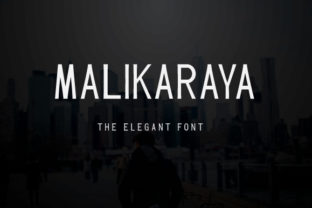
Malikaraya: A Modern Sans Serif Font for Purposeful Typography
Malikaraya is a contemporary sans serif typeface designed with clarity, neutrality, and versatility in mind. It features clean lines, even stroke contrast, and open letterforms—characteristics that support both screen legibility and print refinement. Unlike highly stylized or geometric sans serifs, Malikaraya balances subtle humanist influences with functional structure, making it adaptable across contexts without sacrificing visual cohesion.
People often explore fonts like Malikaraya when refining brand identity, designing book covers, laying out editorial content, or preparing digital assets for fashion or lifestyle publications. Its restrained aesthetic avoids trend-driven exaggeration, supporting long-term usability rather than short-lived novelty. That said, Malikaraya is not a universal solution—it serves best when specific typographic goals align with its inherent qualities.
Why Consider Malikaraya?
Designers and communicators may be drawn to Malikaraya for several practical reasons. First, its neutral tone allows it to recede appropriately behind content—ideal for titles or headings where emphasis should rest on meaning, not ornamentation. Second, its consistent x-height and generous counters improve readability at smaller sizes, especially in body text applications such as book interiors or magazine articles. Third, the font family typically includes multiple weights (e.g., Light, Regular, Medium, Bold) and corresponding italics, enabling clear typographic hierarchy without switching typefaces.
For branding projects, Malikaraya supports minimalism without appearing sterile. Its lowercase a and g retain gentle curves, adding quiet warmth while preserving professionalism. This makes it suitable for sectors where credibility and approachability matter—such as publishing houses, independent fashion labels, or cultural institutions seeking refined yet accessible visual language.
Benefits and Realistic Expectations
One of Malikaraya’s primary strengths is its predictability. It performs consistently across devices and rendering environments, with few display anomalies in web use when properly embedded. Its spacing and kerning are tuned for balanced word shapes, reducing the need for manual micro-adjustments in layout software.
However, users should expect what Malikaraya does not offer: high contrast, dramatic terminals, or strong personality cues. It lacks the expressive flair of display-oriented sans serifs like Inter or Manrope, nor does it match the historical grounding of humanist options like Lora or Source Sans Pro. That absence is intentional—not a limitation, but a design decision prioritizing utility over distinction.
Also, while Malikaraya supports Latin-based languages comprehensively, its character set may not extend deeply into extended Cyrillic, Greek, or non-Latin scripts unless explicitly stated by the foundry. Users working with multilingual content should verify glyph coverage before committing to full implementation.
Situations Where Malikaraya Fits Well
Malikaraya excels in scenarios demanding typographic reliability over stylistic statement. For example:
- Book design: Its regular weight works well for chapter titles; lighter variants support subheads or captions without competing visually with body text.
- Fashion or lifestyle magazines: Clean, uncluttered headlines allow photography and layout to dominate, while consistent typography reinforces editorial tone.
- Brand systems requiring scalability: From business cards to website headers, Malikaraya maintains coherence without needing companion fonts for basic hierarchy.
- Digital-first publishing: Responsive line heights and optimized hinting help preserve readability on mobile screens, especially in longer-form reading interfaces.
In each case, the value lies less in what Malikaraya adds and more in how little it distracts—supporting communication rather than overshadowing it.
When Alternatives May Be More Appropriate
Malikaraya is less suited for contexts requiring strong differentiation or emotional resonance. If a project calls for immediate visual impact—such as a bold campaign poster, a tech startup logo aiming for innovation cues, or a children’s publication needing friendliness—a more distinctive sans serif or even a carefully selected serif might serve better.
Similarly, designers working under tight technical constraints—like legacy CMS platforms with limited font-loading capabilities—or those needing extensive OpenType features (stylistic sets, discretionary ligatures, contextual alternates) should confirm Malikaraya’s feature set matches their workflow. Some versions may prioritize simplicity over advanced typographic controls, which could affect fine-tuning options in professional design tools.
For teams already invested in widely supported, open-source alternatives—such as Roboto, Open Sans, or Inter—switching to Malikaraya introduces licensing considerations and integration effort. Unless its specific balance of neutrality and warmth delivers measurable benefit for the use case, sticking with established options may reduce friction without compromising outcomes.
Making an Informed Choice
Evaluating Malikaraya requires matching its attributes to concrete needs—not just aesthetic preference. Start by identifying your primary typographic roles: Is the font mainly for headlines? Will it appear in UI components? Does it need to pair with a serif for body copy? Testing real content—not placeholder text—is essential. Try setting actual headlines, pull quotes, and navigation labels using Malikaraya alongside your current or candidate fonts. Pay attention to rhythm, spacing, and how easily readers can parse information at intended sizes.
Also consider operational factors. Does your team have access to the full family? Are web licenses included, or will variable font usage require additional configuration? How does it render in dark mode or under low-bandwidth conditions? These details often influence long-term satisfaction more than initial visual appeal.
Finally, recognize that font choice is rarely about finding “the best” option—but rather the most appropriate one for a defined purpose, audience, and medium. Malikaraya earns consideration when clarity, consistency, and quiet authority are priorities—and when its lack of overt character is itself an asset.
If your goal is dependable performance across diverse applications without stylistic compromise, Malikaraya warrants close review. If instead you seek expressive flexibility, broad language support out of the box, or seamless integration with existing tooling, comparing it against alternatives with verified compatibility and feature depth remains a necessary step.